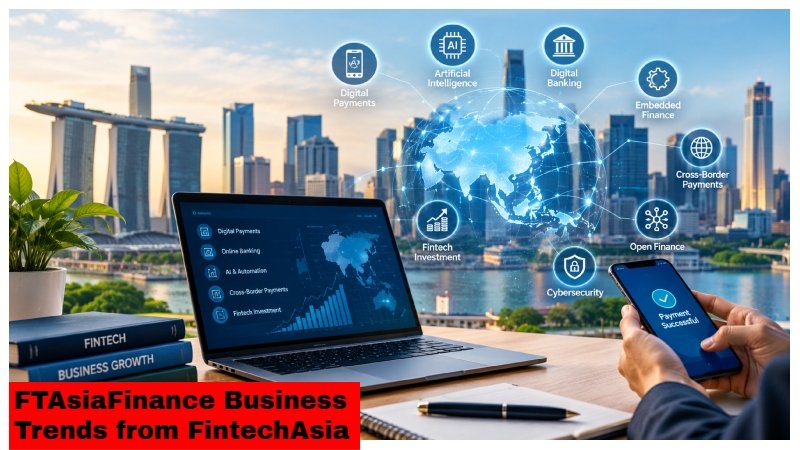
Financial technology is transforming how companies move money, serve customers, manage risk, and compete in digital markets. Across Asia, developments in digital payments, artificial intelligence, online banking, and cross-border transactions are creating new opportunities for businesses while raising important questions about security and regulation. Understanding ftasiafinance business trends from fintechasia can help readers explore these changes and identify which developments deserve attention in 2026.
However, understanding a financial technology trend requires more than following headlines. Businesses need to know how a technology works, where it creates value, what risks it introduces, and whether it suits their market. This guide examines the major developments shaping Asian fintech and offers practical ways for entrepreneurs, financial professionals, and business owners to evaluate them.
What Do FTAsiaFinance Business Trends from FintechAsia Mean?
The phrase connects online searches about FTAsiaFinance and FintechAsia with broader discussions of business innovation and financial technology in Asian markets. Relevant topics include digital banking, mobile payments, financial automation, fintech investment, online lending, and cybersecurity.
The exact organizational relationship between FTAsiaFinance and FintechAsia is not established here through authoritative public evidence. Readers should therefore verify any claims about a specific company, platform, or publication before relying on them.
The wider subject, however, is important. Financial technology is changing how businesses collect revenue, access financial services, organize transactions, and communicate with customers. These developments affect not only banks and major technology companies but also small retailers, e-commerce businesses, service providers, and startups.
The central question is not whether every business should adopt the newest technology. It is which innovations solve real problems, improve financial operations, and create sustainable value.
1. Digital Payments Are Changing the Customer Experience
Digital payments have become an important part of modern commerce. Mobile wallets, QR-code payments, bank transfers, and real-time payment systems allow customers to pay through different channels, depending on what is available in their country.
For businesses, offering suitable payment options can make checkout more convenient and support online sales. Electronic transaction records may also simplify bookkeeping, payment reconciliation, and sales reporting.
Consider a small retailer that previously accepted cash only. Introducing an established digital payment method could make purchasing easier for customers who prefer mobile transactions. The retailer could then evaluate whether the additional payment option improves sales or reduces administrative work.
Yet digital payments also involve costs and risks. Processing fees, delayed settlements, refund policies, transaction limits, and fraudulent payments can affect profitability.
What businesses should do: Compare payment providers based on total costs, settlement speed, security, customer preferences, and integration with existing systems. The right solution is the one that improves the payment experience without creating unnecessary operational burdens.
2. Artificial Intelligence Is Improving Financial Workflows
Artificial intelligence is becoming increasingly relevant to financial services. Depending on the application, AI systems can help analyze transactions, categorize expenses, process documents, identify unusual activity, and support customer service.
These capabilities can be valuable for businesses that handle large amounts of financial information. For example, an accounting team may use automation to extract invoice details and organize expenses before a human reviewer checks the records.
Financial institutions can also use AI-assisted systems to prioritize fraud investigations or identify patterns that deserve further examination.
However, AI is not a substitute for sound financial judgment. Automated systems can produce inaccurate results, overlook unusual cases, or generate misleading predictions when the underlying information is incomplete.
Privacy is another concern. Financial documents may contain confidential customer information, account details, or commercially sensitive data.
What businesses should do: Start with a specific, low-risk task such as document classification or expense organization. Check accuracy, protect confidential information, and retain human oversight for important financial decisions.
3. Digital Banking Is Creating New Options for Businesses
Digital banking enables customers to manage selected financial services through websites and mobile applications. Depending on the provider, businesses may be able to transfer funds, review statements, manage payments, and connect transactions with accounting software.
These features can reduce administrative work and make financial information easier to access. They may be particularly useful for businesses that operate online or manage transactions across multiple locations.
Nevertheless, the term digital banking covers different types of services. A licensed bank, a regulated payment institution, and a technology company offering financial tools may operate under different rules and provide different protections.
Businesses should not assume that every app offering financial services is a bank or that every account receives the same protection.
What businesses should do: Verify the provider’s legal status, account terms, applicable deposit protection, transaction limits, fees, and customer support arrangements. Keep secure access procedures in place and understand how to recover access if an account becomes unavailable.
4. Embedded Finance Is Bringing Financial Services Into Business Platforms
Embedded finance refers to integrating financial services into platforms that customers or businesses already use. Examples include payment processing within an online store, financing options inside a marketplace, or insurance offered during a digital purchase.
The advantage is convenience. Customers can complete more steps within a familiar environment, while businesses may reduce the need to manage several separate systems.
For example, an online seller may use an e-commerce platform that combines order management, payment collection, and transaction reporting. This integration can simplify daily operations and reduce manual data entry.
However, integrated services can create dependence on a single provider. Changes in fees, service availability, or contract terms may affect the business’s ability to operate.
Financing products also require particular care. Easy access to credit does not necessarily mean that borrowing is affordable.
What businesses should do: Review service charges, contract conditions, data-sharing practices, financing costs, and exit options before committing. Choose integrated services because they offer measurable benefits, not simply because they are convenient.
5. Cross-Border Payments Are Important for Asian Businesses
Asia includes a wide range of markets with different currencies, banking systems, payment networks, and regulatory requirements. Companies involved in international trade must navigate these differences when receiving customer payments, paying suppliers, or compensating overseas contractors.
Cross-border payment services are evolving to improve transaction speed, transparency, and connectivity. Depending on the countries and providers involved, businesses may have access to digital transfer services, international payment platforms, or interconnected payment networks.
For a small exporter, the cost of receiving an international payment can directly affect profit margins. Exchange-rate differences and intermediary charges may make two apparently similar services significantly different in their total costs.
Speed is not the only consideration. Payment documentation, identity verification, sanctions screening, and local regulations may influence when funds become available.
What businesses should do: Compare the complete cost of international transactions, including exchange rates and additional fees. Confirm supported currencies, settlement times, documentation requirements, and procedures for resolving disputed payments.
6. Open Finance Is Making Financial Data More Connected
Open finance involves the authorized sharing of financial information between providers under applicable permissions, technical standards, and regulations. It can help connect banking services, accounting software, payment platforms, and other financial applications.
For businesses, this connectivity may reduce manual work and provide a clearer picture of financial activity. Instead of checking several disconnected systems, an authorized integration may allow selected information to appear in one place.
For example, a business owner could connect a business account to approved accounting software. Transactions may then be imported automatically, making it easier to organize expenses and prepare financial reports.
The benefits depend on data quality and the reliability of the integration. Incorrect categorization or interrupted connections can still create errors.
Privacy also matters. Financial data should not be shared without appropriate authorization and safeguards.
What businesses should do: Use trusted integrations, review permissions carefully, limit access to necessary information, and understand how to revoke authorization. Automated financial records should still be reviewed for accuracy.
7. Cybersecurity Is Essential to Financial Technology
As more transactions move online, financial security becomes a business priority. Phishing, stolen credentials, fraudulent invoices, and unauthorized account access can cause direct losses and disrupt operations.
Small businesses can be particularly vulnerable when they lack dedicated security teams or formal procedures for handling suspicious activity.
Effective protection begins with basic controls. Businesses should enable multifactor authentication, use unique passwords, update software, restrict employee permissions, and monitor account activity.
Payment-related fraud also requires clear communication procedures. A request to change a supplier’s bank details should be verified through a separate, trusted channel rather than accepted solely on the basis of an email.
Technology providers also need to be assessed carefully. Marketing claims alone do not demonstrate that a service has strong security practices.
What businesses should do: Establish a written procedure for reporting suspicious transactions, train employees to recognize common scams, and review how financial providers protect data and respond to incidents.
8. Fintech Investment Is Increasing the Focus on Business Fundamentals
Investment activity can help readers understand how investors assess financial technology companies. Funding levels, deal activity, and the types of businesses attracting investment provide useful context, but they should not be treated as direct measures of future success.
Fintech companies may attract investment for payment infrastructure, lending technology, digital financial services, fraud prevention, or business software. Investor interest can change as economic conditions, interest rates, regulation, and business performance evolve.
For startups, attracting funding is only one part of building a sustainable company. A business must also demonstrate that customers need its product, that the service can operate reliably, and that revenue can eventually support costs.
For example, a payment startup may gain customers quickly but struggle if transaction margins are too small. A lending platform may grow its loan portfolio but face losses if its risk assessment is inadequate.
What businesses should do: Evaluate fintech companies based on product usefulness, customer retention, revenue quality, operating costs, compliance readiness, and risk management. Verify investment statistics through original research reports before using them in business decisions or published articles.
9. Digital Lending Can Expand Financing Options
Access to finance remains an important issue for many small businesses. Some fintech lenders use digital applications and additional transaction information to assess eligible borrowers, potentially offering an alternative to traditional application processes.
Depending on the provider and jurisdiction, these services may help businesses apply for working capital or other forms of financing.
However, faster applications do not automatically mean lower costs or better lending decisions. Interest, service charges, repayment schedules, penalties, and eligibility rules can vary considerably.
Businesses should also consider how repayments fit into expected cash flow. Borrowing to cover a temporary gap may be reasonable in some circumstances, but taking on debt without a clear repayment plan can increase financial pressure.
What businesses should do: Compare the total repayment amount, annualized borrowing costs where available, contract terms, and alternative funding options. Verify the lender’s authorization where required and avoid making decisions based solely on advertised approval speed.
10. Regulation and Consumer Protection Will Shape Fintech Growth
Financial technology operates within a changing regulatory environment. Depending on the service and market, companies may need to meet requirements covering customer identification, anti-money-laundering controls, payment processing, lending, privacy, and the handling of customer funds.
These obligations can affect how products are designed, where they can be offered, and how companies expand internationally.
For businesses operating across Asia, the challenge is that legal requirements are not identical in every country. A provider permitted to offer one service in one market may face additional licensing or compliance requirements elsewhere.
Responsible regulation can also support customer confidence by establishing expectations for transparency, security, and accountability.
What businesses should do: Check the requirements that apply to their specific product and jurisdiction. For decisions involving lending, investments, payment services, or customer funds, consult the relevant regulator or a qualified professional rather than relying on general online summaries.
11. Financial Inclusion Remains an Important Opportunity
Financial technology can help make certain financial services more accessible to people and businesses that face barriers to traditional banking. Digital accounts, electronic payments, and remote service delivery may reduce some of the practical difficulties associated with accessing financial services.
Small enterprises may benefit from more convenient payment methods and improved access to financial information. Consumers may also gain additional ways to receive money or make purchases, depending on local infrastructure and eligibility requirements.
However, access to a digital service does not automatically guarantee financial inclusion. Users may still face barriers involving connectivity, device affordability, digital literacy, identification requirements, or service fees.
Digital products must also be understandable and accessible to the people they are intended to serve.
What businesses should do: Consider customer needs, affordability, accessibility, language, and ease of use when selecting financial tools. Services that are technically advanced but difficult for customers to use may fail to deliver their intended benefits.
How Small Businesses Can Choose the Right Fintech Solutions
Understanding industry trends is useful, but choosing a technology requires a clear decision-making process. Businesses do not need to adopt every new service to remain competitive.
Start with a measurable problem
Identify the issue that needs improvement. It might be slow payment collection, expensive international transfers, repetitive bookkeeping, poor transaction visibility, or difficulty protecting financial accounts.
Compare the total cost
Look beyond advertised prices. Include transaction fees, currency conversion, subscriptions, integration expenses, staff training, and any additional costs required to operate the service.
Verify the provider
Check relevant regulatory registrations, official documentation, customer support, security policies, and contractual terms. Be cautious of providers that make unrealistic promises or cannot clearly explain how their services work.
Run a limited test
Where practical, introduce the solution on a small scale before moving important operations. Compare results against the previous process using measurable indicators such as time saved, errors reduced, or transaction costs.
Protect information and review performance
Set access permissions, train employees, maintain appropriate backups, and review results regularly. A service that initially appears useful may need to be replaced if its costs rise or its performance falls short.
This process helps businesses make informed decisions based on evidence rather than technology hype.
What to Watch in Asian Fintech Over the Next Few Years
Several areas deserve continued attention as financial technology evolves.
Payment interoperability: Better connections between payment networks could make transactions more convenient, although implementation depends on participating institutions and local rules.
Practical AI applications: Financial organizations may continue exploring automation and analytical tools, with accuracy, governance, and data protection remaining important considerations.
Fraud prevention: As payment methods change, financial institutions and businesses will need to keep improving their ability to identify suspicious activity.
Financial data connectivity: Authorized integrations may make it easier for businesses to combine information from different financial services.
Responsible digital finance: Consumer protection, regulatory compliance, and transparent pricing will remain important to sustainable adoption.
The pace of progress will differ by country, provider, and customer group. Businesses should monitor verified announcements and credible research rather than assume that every emerging technology will become widely adopted.
Conclusion
FTAsiaFinance business trends from FintechAsia provide a starting point for exploring the broader changes affecting financial technology and business activity across Asia. Digital payments, artificial intelligence, online banking, embedded finance, cross-border transactions, open finance, and cybersecurity each offer potential benefits, but their value depends on implementation, cost, security, and regulatory requirements.
For entrepreneurs and established companies, the most effective strategy is to identify a genuine need, verify the provider, compare alternatives, and measure results. Financial technology should make a business more efficient, resilient, or accessible—not introduce complexity without a clear benefit.
As the sector develops, informed decisions and trustworthy information will remain more valuable than following every new trend. Click here for more information.
Frequently Asked Questions
What does FTAsiaFinance business trends from FintechAsia mean?
The phrase appears in online content associated with financial technology and business developments in Asia. The exact official relationship between FTAsiaFinance and FintechAsia should be verified independently before making claims about a particular organization.
What are the most important fintech trends in Asia?
Major areas include digital payments, AI-assisted financial operations, digital banking, embedded finance, cross-border payments, open finance, cybersecurity, and digital lending.
How can fintech benefit small businesses?
Depending on the market and provider, financial technology can simplify payment collection, reduce manual bookkeeping, improve transaction visibility, and support online sales.
Is digital banking safe for businesses?
Digital banking can provide secure services, but safety depends on the provider’s controls and the customer’s practices. Businesses should verify the provider, protect credentials, enable multifactor authentication, and monitor account activity.
How can businesses reduce cross-border payment costs?
They can compare exchange rates, transfer fees, intermediary charges, supported currencies, and settlement times. Reviewing the total cost is more useful than comparing advertised fees alone.
Should small businesses adopt AI financial tools?
Only when a tool addresses a genuine need and offers measurable value. Accuracy, privacy, security, cost, and human oversight should be considered before adoption.
How can a company evaluate a fintech provider?
Review its regulatory status where applicable, pricing, security practices, data policies, customer support, contract terms, and independent reputation. Verify important claims through official documentation and relevant regulators.
Why is cybersecurity important in financial technology?
Financial services handle money and sensitive information. Weak security can expose businesses to fraud, unauthorized access, operational disruption, and financial losses.
Does fintech investment guarantee business success?
No. Investment can provide resources for growth, but success also depends on customer demand, revenue quality, operating costs, risk management, and regulatory compliance.