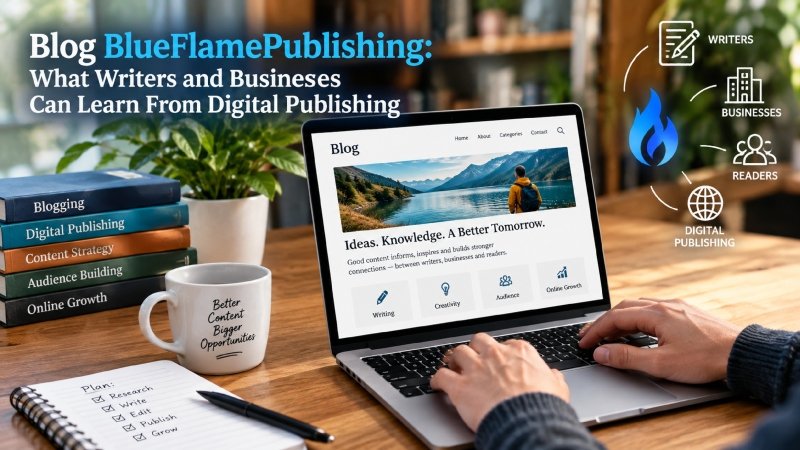
Digital publishing has changed the way writers, entrepreneurs, and businesses share information. A blog is no longer simply a place to post personal thoughts. Today, it can help a writer demonstrate expertise, help a business educate potential customers, and give readers a reliable place to explore useful ideas. That is why searches for Blog BlueFlamePublishing are becoming relevant to people interested in blogging, writing, publishing, audience building, and online growth. Current pages using the BlueFlamePublishing name describe a broad publishing concept that connects writing, readers, creativity, digital content, and publishing.
But there is an important lesson beyond the name itself: successful digital publishing depends on the value of the information, not simply on the number of articles published.
What Is Blog BlueFlamePublishing?
BlueFlamePublishing is presented online as a publishing and blogging concept focused on writers, readers, ideas, and digital content. Its published material discusses subjects such as blogging, creativity, writing, digital publishing, audience development, and online growth.
However, readers should be careful when researching the name because search results contain several similarly named domains. A page appearing in search results under a related BlueFlamePublishing name should not automatically be assumed to represent the same organization.
For that reason, checking the exact domain, author information, About page, and editorial context is a sensible step before relying on a particular page.
This is especially important for business owners and writers who use online publishing information to make decisions.
Why Is BlueFlamePublishing Relevant to Modern Blogging?
The traditional idea of blogging was relatively simple: write an article and publish it online.
That approach is no longer enough.
Modern blogging combines several activities:
- Researching what readers actually need
- Creating original information
- Organizing content clearly
- Building an identifiable author or brand
- Promoting useful resources
- Maintaining editorial quality
- Understanding search behavior
- Updating information when circumstances change
Several BlueFlamePublishing-related pages emphasize the connection between blogging, digital identity, creativity, and audience growth.
This reflects a wider change in online publishing. Readers have more content available than ever, so simply producing another article is unlikely to create lasting value.
What Can Writers Learn From the BlueFlamePublishing Concept?
Writers can take several practical lessons from the broader publishing model.
Write for a Real Audience
Before writing an article, ask a simple question:
Who is this information supposed to help?
A beginner may need definitions and examples. A professional may want practical strategies or comparisons. A business owner may be looking for information that can support a decision.
When the intended reader is clear, the article becomes easier to structure and more useful.
Develop a Recognizable Voice
Thousands of websites may discuss the same subject. What separates strong content from generic content is often the writer’s perspective.
A recognizable voice does not mean adding unnecessary personal opinions. It means explaining information clearly, choosing useful examples, and presenting ideas in a way that feels purposeful.
For writers trying to build an online identity, this can be more valuable than simply publishing as frequently as possible.
Give Every Article a Purpose
A good article should have a reason for existing.
It might answer a question, explain a complicated process, compare options, solve a problem, or introduce a useful perspective.
If an article could be removed from the internet without readers losing anything valuable, it probably needs stronger information.
This is one area where businesses can learn from digital publishing: content should solve a reader problem rather than exist only to attract clicks.
How Businesses Can Use Digital Publishing
The publishing model is not limited to authors.
Small businesses, consultants, agencies, and entrepreneurs can use educational content to demonstrate their knowledge and help potential customers.
For example, a financial consultant could publish an explanation of common budgeting mistakes. A marketing agency could explain how businesses can evaluate their website traffic. A software company could create practical guides showing customers how to solve common problems.
None of these articles needs to be an advertisement.
In fact, useful educational content can be more effective when it answers the reader’s question first and promotes a service only when it is genuinely relevant.
Content Quality Matters More Than Content Volume
One of the biggest mistakes new bloggers make is assuming that publishing more articles automatically produces better results.
It does not.
A website with 50 shallow articles may provide less value than a website with 15 well-researched resources.
Quality content should generally be:
- Accurate
- Original
- Easy to understand
- Relevant to the intended audience
- Properly organized
- Supported by trustworthy information when needed
- Free from unnecessary repetition
The same principle appears in BlueFlamePublishing-related discussions about originality, consistency, and providing readers with meaningful ideas.
How SEO Fits Into Digital Publishing
Search engine optimization can help useful content become easier to discover, but SEO should not become the purpose of the article.
For a topic such as blog BlueFlamePublishing, a strong page should naturally answer the questions a searcher may have instead of repeating the exact phrase in every paragraph.
A sensible SEO structure might include:
- A clear title that accurately describes the topic
- A concise introduction
- Descriptive headings
- Natural use of relevant terminology
- Helpful examples
- Clear answers to related questions
- Internal links to genuinely relevant resources
- A useful conclusion
This approach makes the page easier for both readers and search engines to understand.
What Makes a Publishing Article Trustworthy?
Trust is particularly important when an article discusses publishing platforms, business opportunities, marketing methods, or other decisions.
Readers should look for signs of responsible publishing.
Clear authorship
A useful article should make it reasonably clear who created it when author expertise matters.
Accurate information
Important claims should be checked rather than repeated simply because another website published them.
Transparency
Websites should make their purpose and editorial approach reasonably understandable.
Useful context
Good content explains limitations instead of presenting every option as universally suitable.
Original value
An article should contribute something useful instead of simply rewriting several existing pages.
These principles are especially important for websites trying to establish long-term authority.
What Authors Should Consider Before Choosing a Publishing Approach
There is no single publishing method that is perfect for every writer.
An author may care about different things, including:
- Creative control
- Publishing speed
- Budget
- Editing support
- Cover design
- Formatting
- Distribution
- Marketing
- Long-term audience development
A writer publishing a first book may have very different needs from an established author with an existing audience.
BlueFlamePublishing-related content also recognizes that publishing decisions depend on the author’s goals, resources, genre, audience, and experience.
The practical lesson is simple: understand the options before choosing one.
How to Create Better Blog Posts
Whether you are writing for yourself or a business, a simple workflow can improve content quality.
Start With the Reader’s Question
Do not begin with the keyword. Begin with the problem.
What does the reader actually want to know?
Research Before Writing
Check reliable sources, examine different viewpoints, and identify information that needs verification.
Build a Logical Structure
Use headings to move from the basic question toward more detailed information.
Add Practical Value
Examples, steps, comparisons, checklists, and useful observations can make an article more actionable.
Edit Ruthlessly
Remove repeated ideas, unnecessary introductions, weak sentences, and claims that cannot be supported.
Review Before Publishing
Check grammar, links, factual details, headings, images, and the overall reading experience.
This process takes more effort than simply generating a large number of posts, but it produces content with much greater potential value.
Common Mistakes in Blogging and Publishing
Several mistakes can weaken an otherwise promising website.
Keyword stuffing
Repeating the same phrase unnaturally makes content harder to read and can reduce its usefulness.
Generic information
Readers do not need another article that says blogging is “important” without explaining why or how.
Copying competitors
Using another website’s structure, wording, or unique ideas too closely can create copyright and originality problems.
Unsupported claims
Statements about traffic, popularity, success rates, or industry results should not be presented as facts without appropriate evidence.
Publishing without editing
Even useful research can look unprofessional when an article contains repetition, grammar problems, or unclear sections.
Writing only for search engines
A page should satisfy the person who clicked the result. Search visibility is valuable, but reader satisfaction comes first.
Is Blog BlueFlamePublishing Useful for Businesses?
The broader concept can be useful for businesses because it highlights an important principle: publishing can support brand authority when the content genuinely helps the audience.
A business should not create a blog simply because every competitor has one.
Instead, it should identify questions customers repeatedly ask and create resources that answer those questions better.
Over time, this can create a useful knowledge base that supports customers before, during, and after a buying decision.
For BusinessDailyGuide readers, this is perhaps the most important takeaway. Blogging should be viewed as part of a wider communication strategy rather than as a shortcut to traffic.
The Future of Digital Publishing
Digital publishing will continue to evolve. Writers now have access to more publishing tools, distribution channels, analytics, and content formats than previous generations.
At the same time, the abundance of content creates a new challenge: earning trust.
Readers can easily find information. Finding information they can trust is harder.
That means future-focused publishers will need to pay attention to originality, accuracy, authorship, usability, and reader experience.
Technology can make publishing faster, but it cannot replace the need for good judgment.
Final Thoughts
The real value behind Blog BlueFlamePublishing is not simply the phrase or the websites appearing for it in search results. It represents a broader discussion about how writers, publishers, and businesses can use digital content to share knowledge and build an audience. Click here for more information.
The strongest lesson is straightforward: publish with a purpose.
Understand the reader. Research carefully. Provide original value. Explain information clearly. Avoid unnecessary keyword repetition. And most importantly, give people a reason to remember what they read.
For writers, that approach can help develop a stronger digital identity. For businesses, it can turn a blog into a useful resource that supports credibility and customer education.
In a crowded publishing environment, the websites that stand out will not necessarily be the ones that publish the most. They will be the ones that consistently give readers something genuinely worth reading.