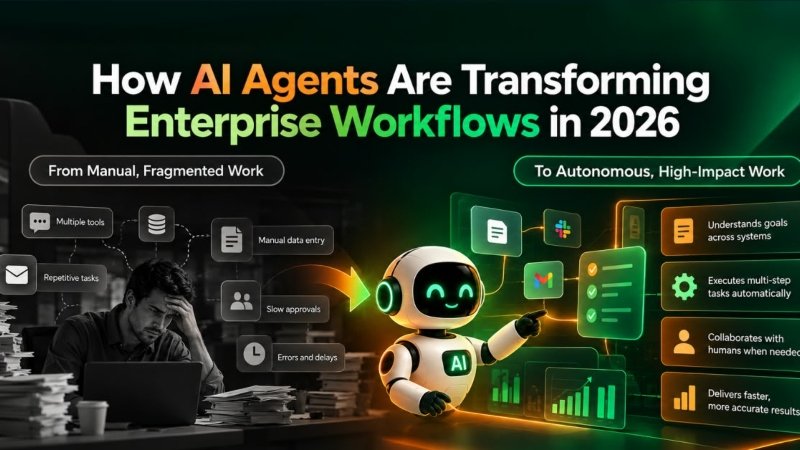
Walk into any technology conference in 2026, and the conversation has changed completely from eighteen months ago. Nobody asks whether AI agents work anymore. They ask which workflow to hand over next, and how fast a competitor already did it.
That change happened faster than most planning cycles could keep up with. Enterprises running small pilots last year are now running production systems across multiple departments. Much of that progress traces back to custom AI agent development built around a specific workflow, rather than a generic tool bought off a shelf. Teams stopped asking for a demo and started asking for a working system tied to their own data.
Conference hallways sound different because results finally caught up with the promises made a year earlier. This article looks at what actually changed. It covers which workflows agents handle well today, and which departments moved first into production.
It also explains why some enterprises remain stuck, even with the same tools everyone else has access to. An AI agent development company watching this pattern closely sees it repeat across nearly every industry it works with.
What Changed in Enterprise AI Adoption Over the Past Year
The biggest change was not technical. Models improved, but the real difference showed up in how businesses approached deployment. Caution gave way to structured confidence, built on lessons from the pilots that came before. Consulting teams working across multiple sectors this year noticed the same pattern in client after client.
● From Pilot Projects to Production Deployments
A pilot used to mean a proof of concept running in isolation, disconnected from real customer data. That definition has changed considerably. A pilot today usually means a scoped production workflow, monitored closely before wider rollout.
Executives stopped asking whether a pilot proved the concept. They started asking how soon it could expand to a second department. That question alone pushed more projects past the pilot stage than any new model release did.
● How Success Got Measured This Year
The metrics defining pilot success have also matured considerably. A year ago, a pilot could succeed simply by demonstrating the concept worked at all.
This year, success means hitting a defined accuracy target and a defined escalation rate before anyone approves the next phase. A well-run pilot now includes a defined path to production written into the plan from the start, not added later.
● Which Industries Moved Fastest
Finance and insurance moved early, since their workflows already followed documented rules. Claims processing, fraud checks, and account queries gave agents a clear structure from day one.
Retail and logistics followed close behind, pushed by seasonal pressure manual processes could never absorb well. Healthcare moved more carefully, constrained by compliance requirements that demanded extra validation before any agent worked with patient data directly.
The Workflows Agents Are Already Handling Well
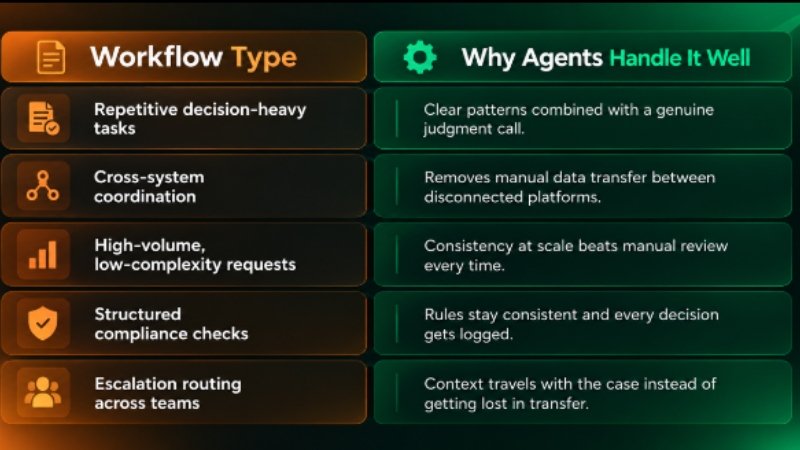
Not every workflow was equally ready for this change. The ones seeing real results share a few common traits worth naming directly.
Repetitive Decision-Heavy Tasks
Tasks that repeat often, follow a recognizable pattern, and involve a real decision are where agents perform best today. Invoice matching, ticket triage, and eligibility checks all fit this description closely. An AI agent development company scoping a new project usually starts by looking for exactly this combination of traits.
These tasks used to consume hours of skilled staff time on work that felt routine but still required judgment. Handing that judgment to an agent freed staff for exceptions that genuinely need a human perspective. The routine work did not disappear. It simply moved to a system built to handle it consistently.
Support teams offer a clear example of this change in practice. Ticket triage that once took a coordinator twenty minutes per case now happens in seconds, with the coordinator stepping in only when the agent flags genuine uncertainty. That pattern repeats across nearly every department running a well-scoped agent today.
Finance teams report a similar story around invoice exceptions. A mismatch that once sat in a queue for two days now gets resolved, or correctly escalated, within minutes of arriving. The staff freed by that change moved to vendor negotiations and forecasting work nobody had time for previously.
Cross-System Coordination That Used to Need Manual Handoffs
Many enterprise workflows span three or four systems that were never designed to talk to each other. A customer request might start in a support platform, pull data from a CRM, and end with an update inside an ERP system.
Agents now manage that coordination directly, without a person copying data between screens. This change alone accounts for a large share of the time savings enterprises report this year. The handoff itself, once the slowest part of the process, has become close to instant in workflows built well.
A well-designed AI agent development company engagement usually starts by mapping every one of these handoffs before writing a line of code. That mapping exercise often reveals more inefficiency than anyone expected, buried inside a process everyone assumed already worked fine.
What Is Still Holding Broader Adoption Back
Progress has not been uniform across every enterprise. A few consistent barriers explain most of the businesses still stuck at the pilot stage.
Trust and Oversight Concerns
Some leadership teams remain uneasy handing real decisions to a system they cannot fully explain. That hesitation is not unreasonable, especially in regulated industries where a wrong decision carries real consequences.
Board-level questions have grown more specific over the past year as well. Executives now ask about escalation triggers and error rates instead of general questions about AI capability. That level of specificity forces a project team to have real answers ready, which naturally improves the project itself.
Some organizations built internal review boards specifically for agent deployments, mirroring the structure many already use for major software changes. That extra step slows initial approval slightly, but it tends to prevent the kind of public misstep that damages trust in every future project.
The businesses that moved past this concern did so through visible oversight, not blind faith. Clear escalation paths, audit logs, and defined human checkpoints gave leadership something concrete to evaluate. Trust followed evidence, not the other way around.
An experienced AI agent development company treats this oversight design as part of the build itself, not an add-on requested after launch. That distinction alone separates the projects leadership approved quickly from the ones stuck in review for months.
Integration Debt With Legacy Systems
Older systems built decades ago usually don’t expose a modern API an agent can use directly. Connecting to them requires custom work that adds real time and cost to a project.
This integration debt has slowed more projects than any concern about the models themselves, without most leadership teams noticing until budgets ran over. Businesses that budgeted honestly for this work moved faster than those who assumed integration would be simple. The technical debt was always there. It just became visible once agents needed to work with it directly.
What Leading Teams Are Doing Differently
A pattern separates the enterprises seeing strong results from those still stuck in pilot purgatory. It has less to do with budget and more to do with sequencing. The businesses reporting the strongest year-over-year gains seldom had the largest teams or the biggest initial investment.
Starting Small Before Scaling to Multi-Agent Systems
Leading teams seldom start with an ambitious multi-agent rollout spanning five departments. They start with one well-scoped workflow, prove it works, and use that proof to justify the next build.
This approach builds internal trust gradually, project by project, rather than betting everything on one large rollout. By the time these teams reach a coordinated multi-agent system, the organization already trusts the underlying approach. That trust makes the harder, more complex build far easier to greenlight.
Budget approval follows a similar pattern this year. A finance team that watched one project deliver on its promise approves the second and third project with far less scrutiny. Momentum, once it starts, tends to carry a program much further than the original business case alone ever could.
Working alongside experienced AI agent consulting partners tends to reinforce this sequencing rather than override it. The businesses that resisted the urge to skip ahead are the ones reporting the strongest results this year.
What to Watch for Through the Rest of the Year
A few developments are worth tracking as this year continues.
- Multi-agent orchestration is maturing quickly, moving from experimental architecture to a standard option for complex workflows. Expect more enterprises to expand from single-task agents into coordinated systems handling entire processes end to end.
- Governance frameworks are catching up to deployment speed.Businesses that treated oversight as an afterthought last year are now building it into the initial design phase instead, which should reduce the number of stalled projects going into next year.
- Talent teams are adjusting too, though more slowly than the technology itself. Job descriptions now mention agent oversight and prompt review as real responsibilities, not side tasks bolted onto an existing role. Expect that trend to accelerate as more departments run agents day to day.
- More industries will start sharing real numbers publicly, rather than vague statements about efficiency gains. As specific results get published, the remaining skeptics inside cautious organizations will have less room to delay a real decision.
- Vendor consolidation is picking up as well. Enterprises that started the year working with three or four point solutions are now asking whether a single AI agent development company can cover more of that ground under one coordinated engagement. Expect more of that consolidation as orchestration matures.
Where This Leaves Enterprise Teams Today
The distance between experimenting with agents and running them in production has closed considerably this year. That progress came from better sequencing and honest budgeting, not just improved models. Enterprises that treated integration debt and oversight seriously moved faster than those chasing an impressive demo.
The workflows seeing the strongest results share the same traits every time. They repeat often, involve a real decision, and used to require a person moving data between disconnected systems. Businesses that identified those workflows early are now expanding into more ambitious builds.
None of this progress required a leap of faith from leadership. It required evidence, built one scoped project at a time, presented honestly alongside its actual limitations. That honesty earned agents a permanent place inside daily operations this year. Click here for more Information.
A capable AI agent development company will tell you which of your workflows fit that description today. Not every process is ready, and pretending otherwise wastes budget on the wrong starting point. Sequencing carefully and building oversight in from day one remain the real difference between a stalled pilot and a system your team depends on.