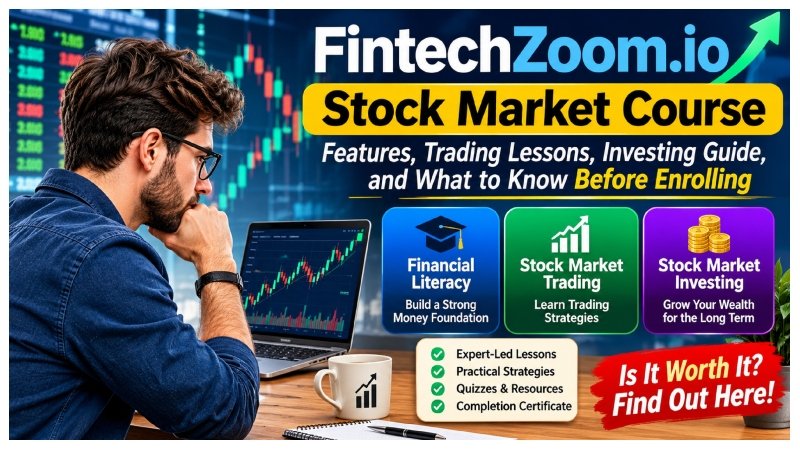
Understanding the stock market can open the door to better financial knowledge, but getting started is not always easy. Beginners often encounter unfamiliar terms such as technical analysis, portfolio diversification, exchange-traded funds, candlestick patterns, and risk management. Without a clear learning path, it can become difficult to understand how financial markets operate and how different investment decisions affect personal finances. The fintechzoom.io stock market course is an online financial education offering that attracts attention from people interested in learning about trading and investing. Its website presents separate programs for stock market trading, stock market investing, and financial literacy. Each program addresses different financial topics, making it important to understand what the provider actually advertises before considering enrollment.
However, course content is only one part of the decision. Prospective students should also examine the teaching information, advertised features, pricing transparency, certificate conditions, and the identity of the organization operating the website.
This guide explores the FintechZoom.io stock market courses, their advertised curriculum, potential learning benefits, limitations, and important precautions that beginners should consider.
What Is the FintechZoom.io Stock Market Course?
FintechZoom.io is a website that presents financial information, market-related content, and online educational programs. Its course section promotes learning opportunities for people who want to improve their understanding of personal finance and financial markets.
Rather than offering just one stock market program, the platform lists three main educational categories:
- Financial Literacy: Introduces budgeting, saving, and essential personal finance concepts.
- Stock Market Trading: Focuses on trading methods, market analysis, price movements, and trading strategies.
- Stock Market Investing: Covers investment fundamentals, portfolio development, diversification, and long-term financial planning.
These programs serve different learning objectives. Financial literacy provides a broader foundation, trading focuses on shorter-term market activity, and investing emphasizes building and managing a portfolio.
The distinction matters because someone interested in long-term financial planning may not need the same lessons as someone exploring active trading.
Understanding the Three FintechZoom.io Courses
Before selecting an educational program, it helps to examine the subjects covered by each option.
Financial Literacy Course
Financial literacy is an important foundation for managing money responsibly. It helps individuals understand income, expenses, savings, budgeting, and financial planning.
FintechZoom.io advertises a financial literacy program for people who want to develop essential money management skills.
Relevant learning areas include:
- Understanding personal income and expenses
- Creating realistic household budgets
- Developing regular saving habits
- Understanding financial goals
- Learning basic investment concepts
- Making informed financial decisions
These subjects are useful for beginners because successful financial planning starts with understanding how money works.
For example, someone who regularly spends more than they earn may benefit from learning budgeting principles before considering stock market investments.
Stock Market Trading Course
The Stock Market Trading Mastery Course is presented as an educational option for people interested in understanding active market participation.
Trading generally involves buying and selling financial instruments to benefit from price changes. Unlike traditional long-term investing, trading may require more frequent market analysis and closer attention to risk.
According to the published course description, the program addresses several trading-related subjects.
Market fundamentals: Understanding different financial markets, how trading works, and how participants buy and sell assets.
Candlestick patterns: Learning how candlestick charts display opening prices, closing prices, highs, and lows. Traders often examine these patterns when studying market behavior.
Trading strategies: Exploring approaches such as day trading, swing trading, and position trading.
Technical analysis: Studying price movements, market trends, indicators, and chart patterns to evaluate potential trading opportunities.
Stop-loss strategies: Understanding how predetermined exit levels can help limit losses when a trade moves against expectations.
Trading psychology: Recognizing the influence of emotions, impatience, fear, and overconfidence on trading decisions.
Algorithmic trading: Exploring how automated systems and predefined rules can support certain trading activities.
The trading course page also advertises approximately four to six hours of on-demand video lessons, practical resources, quizzes, and a completion certificate.
These are features described by the provider. Prospective students should request a complete syllabus and confirm which subjects receive detailed practical instruction.
Stock Market Investing Course
The FintechZoom Investment Mastery Course is designed around investment knowledge and portfolio management.
Investing generally involves purchasing financial assets with the expectation that they may increase in value or generate income over time. It requires an understanding of financial objectives, risk tolerance, market conditions, and investment choices.
The published curriculum covers several important areas.
Investment fundamentals: Learning about risk and return, compounding, financial objectives, and different asset classes.
Stocks and equities: Understanding how shares represent ownership in publicly traded companies and why their prices fluctuate.
Bonds and fixed-income investments: Exploring how government and corporate bonds work and how they differ from equities.
Exchange-traded funds: Understanding ETFs and how they provide access to groups of securities through a single investment product.
Portfolio diversification: Learning why spreading investments across different assets can reduce exposure to individual investment risks.
Value and dividend investing: Exploring approaches that focus on company valuation and investments that distribute dividends.
Passive index investing: Understanding how index-based strategies provide exposure to broader financial markets.
International investing: Examining opportunities and risks associated with investing in markets outside an investor’s home country.
The course also mentions behavioral finance, artificial intelligence, machine learning, robo-advisors, portfolio rebalancing, and investment risk management.
Its published page advertises approximately seven to eight hours of on-demand video lessons, printable worksheets, interactive quizzes, and a certificate of completion.
These subjects provide a broad introduction to investment concepts, although readers should distinguish between a published curriculum and independently verified teaching quality.
FintechZoom.io Trading vs. Investing: What Is the Difference?
One of the most important decisions beginners face is choosing between active trading and long-term investing.
Although both involve financial markets, they require different approaches.
| Factor | Stock Market Trading | Stock Market Investing |
|---|---|---|
| Main objective | Benefit from price movements | Build wealth over time |
| Typical timeframe | Shorter periods | Usually several years |
| Research approach | Technical analysis and market trends | Financial and fundamental analysis |
| Activity level | Often requires frequent monitoring | Generally less frequent monitoring |
| Common strategies | Day trading and swing trading | Value and index investing |
| Main challenge | Managing volatility and trading discipline | Managing long-term investment risk |
Trading can require considerable attention, preparation, and emotional discipline. Frequent transactions may also create additional costs.
Long-term investing generally places greater emphasis on financial goals, asset allocation, diversification, and patience.
Neither approach guarantees positive results. Beginners should understand the risks before choosing a strategy.
What Learning Features Does FintechZoom.io Advertise?
The platform describes several features intended to make its educational programs accessible to different types of learners.
Self-Paced Video Lessons
FintechZoom.io promotes on-demand learning, allowing students to study according to their schedules.
The advertised video durations differ between the two stock market programs:
- Trading course: Approximately four to six hours.
- Investing course: Approximately seven to eight hours.
A flexible learning schedule may be convenient for students and working professionals. However, the actual time required to understand and practice the material may be considerably longer.
Practical Learning Resources
The individual course pages mention downloadable materials, including charts, strategy guides, and printable worksheets.
Such resources can help learners organize financial information, review lessons, and practice concepts.
For example, an investor might use a worksheet to record financial objectives, investment assumptions, and portfolio allocation.
Interactive Quizzes
Quizzes can help students review important concepts and identify subjects they need to study again.
However, passing an online quiz does not necessarily demonstrate that someone can analyze a company, manage a portfolio, or make appropriate trading decisions.
Practical understanding requires continued learning and independent research.
Certificate of Completion
Both stock market course pages advertise a certificate after successful completion.
A completion certificate can document participation in an educational program. However, it should not automatically be considered equivalent to a university qualification, professional financial certification, or securities license.
Students who need a recognized professional qualification should verify accreditation independently.
Learning Support and Updates
The general courses page also advertises learner support, course updates, and a community-based learning experience.
These features may be useful, but prospective students should confirm how support works, whether it is included in the enrollment price, and what access conditions apply.
Who Should Consider Learning Through FintechZoom.io?
Different learners have different financial education requirements. Understanding your objectives can help determine whether an advertised course is relevant.
Beginners With Limited Financial Knowledge
People new to financial markets may benefit from studying basic concepts before exploring more advanced strategies.
Financial literacy, investment fundamentals, and market terminology can provide a useful starting point.
Aspiring Stock Traders
Individuals interested in active trading may want to study technical analysis, candlestick patterns, trading psychology, and risk management.
However, they should look for practical exercises and a clear explanation of the risks associated with different trading methods.
Long-Term Investors
People interested in building a portfolio over several years may find topics such as asset allocation, index investing, diversification, and dividend strategies more relevant.
These concepts can help learners understand how different investments contribute to broader financial objectives.
Working Professionals
People balancing employment and education may appreciate self-paced learning arrangements.
Nevertheless, they should evaluate the course schedule, access conditions, support availability, and total cost before enrolling.
Is FintechZoom.io Legitimate? Important Website Verification
This question deserves particular attention because the FintechZoom name appears across more than one domain.
FintechZoom.io publishes its own financial content and educational course descriptions. However, having a functioning website and a detailed curriculum does not independently establish the identity, authorization, or credibility of the organization operating it.
There is a significant distinction between FintechZoom.io and FintechZoom.com.
FintechZoom.com identifies itself as the official FintechZoom website and has published a warning stating that fintechzoom.io is not affiliated with its official platform. Its warning specifically identifies the .io domain among websites it describes as impersonating its brand.
This is a statement made by FintechZoom.com, and readers should take it seriously when evaluating the course.
It does not, by itself, independently establish the quality or legal status of every service advertised on the .io website. However, prospective students should not assume that the two domains represent the same organization.
Before considering enrollment, take the following precautions.
Verify the Course Provider
Identify the company or legal entity responsible for delivering the training.
Look for verifiable business information, contact details, and clear explanations of who operates the educational service.
Investigate Instructor Qualifications
The website describes its programs as offering expert-led guidance, but general promotional language is not enough to establish professional qualifications.
Ask for instructor names, relevant experience, and verifiable financial education credentials.
Review the Complete Curriculum
A detailed syllabus should identify individual lessons, learning objectives, assignments, and practical activities.
This helps determine whether the program provides meaningful instruction or mainly presents broad descriptions of financial topics.
Check Pricing Before Paying
The publicly available course descriptions reviewed do not clearly establish a fixed enrollment price.
Ask the provider for the complete cost, payment terms, and information about any additional or recurring charges.
Avoid making a payment based only on promotional messages.
Understand the Refund Conditions
The general courses page advertises a 30-day satisfaction guarantee.
However, a promotional statement is not a substitute for written refund terms. Ask for the full policy and check the eligibility requirements, refund process, and any restrictions.
Protect Personal and Financial Information
Never share banking passwords, account credentials, or sensitive financial information with an unverified organization.
Check the payment destination and make sure you understand who will receive your money.
Advantages and Limitations of the FintechZoom.io Stock Market Course
A balanced review should consider both the advertised learning features and the information that remains unclear.
| Potential advantages | Limitations and concerns |
|---|---|
| Separate trading and investing programs | Domain affiliation requires careful verification |
| Broad financial education topics | Instructor identities need independent verification |
| Self-paced video lessons advertised | Actual teaching quality is not independently established |
| Quizzes and learning materials advertised | Detailed practical training should be confirmed |
| Certificate of completion advertised | Professional accreditation is not established |
| Multiple experience levels addressed | Fixed course pricing is not clearly displayed |
| Refund guarantee advertised | Written refund conditions should be checked |
These points are based on the provider’s published information and available website statements, not independently verified student outcomes.
The distinction is important when comparing online financial education programs.
How to Choose a Reliable Stock Market Course
FintechZoom.io is not the only option available to people who want to learn about financial markets.
Before purchasing any educational program, compare several important factors.
1. Course transparency: Look for a detailed syllabus, clear lesson descriptions, and realistic learning objectives.
2. Instructor experience: Check whether the instructors have relevant qualifications and verifiable professional backgrounds.
3. Practical education: Prefer programs that explain concepts through examples, exercises, and realistic financial scenarios.
4. Risk management: A good financial education program should explain potential losses rather than focus only on possible profits.
5. Independent reviews: Examine feedback from multiple sources and distinguish genuine student experiences from promotional content.
6. Pricing and refund terms: Understand the complete cost and refund conditions before providing payment information.
7. Provider identity: Confirm the organization’s legal identity and whether it is connected to any brand it uses in its marketing.
For additional beginner education, readers can explore free resources from established organizations such as the U.S. Securities and Exchange Commission’s Investor.gov and the U.S. Financial Industry Regulatory Authority (FINRA).
These resources provide useful information about investment basics, market risks, and investor protection.
Common Mistakes Beginners Should Avoid When Learning Stock Market Trading
Even a well-structured educational program cannot eliminate the mistakes that beginners sometimes make.
Understanding these problems early can help new market participants develop better habits.
Investing Without Understanding the Asset
Buying a stock simply because someone recommends it can lead to poor financial decisions.
Learn about the company, its business model, financial condition, and potential risks before considering an investment.
Ignoring Risk Management
Every investment carries some degree of uncertainty.
Beginners should understand diversification, position sizing, liquidity, and the possibility of losing money.
Expecting Quick Profits
The stock market does not provide guaranteed returns. Trading strategies that appear successful in examples may perform differently under actual market conditions.
Following Unverified Investment Advice
Social media posts, anonymous recommendations, and unrealistic profit claims should never replace independent research.
Trading With Borrowed Money
Margin trading and other leveraged strategies can increase potential losses.
New investors should understand how leverage works and why it can create substantial financial risks.
Confusing Education With Professional Expertise
Completing a course may improve financial knowledge, but it does not automatically make someone a professional trader or investment adviser.
Continuous learning and practical experience remain important.
Frequently Asked Questions
What is the fintechzoom.io stock market course?
It refers to the financial education programs advertised on FintechZoom.io. The website lists separate courses covering financial literacy, stock market trading, and stock market investing.
Is FintechZoom.io suitable for beginners?
The platform markets its courses to beginners and people with different experience levels. However, students should review the curriculum and verify the provider before enrolling.
What does the FintechZoom.io trading course teach?
Its published description includes market fundamentals, candlestick patterns, day trading, swing trading, technical analysis, stop-loss strategies, trading psychology, market indicators, and algorithmic trading.
What does the FintechZoom Investment Mastery Course cover?
The investing program describes subjects such as stocks, bonds, ETFs, asset allocation, diversification, value investing, dividend strategies, portfolio management, and international markets.
How long do the stock market courses take?
The website advertises approximately four to six hours of on-demand video lessons for the trading program and seven to eight hours for the investing program.
Does FintechZoom.io provide a certificate?
Yes. The individual stock market course pages advertise certificates of completion. However, readers should not assume these certificates represent an independently accredited financial qualification.
How much does the FintechZoom.io stock market course cost?
The publicly reviewed course pages do not clearly display a fixed enrollment price. Contact the provider for current pricing and complete payment conditions.
Is FintechZoom.io affiliated with FintechZoom.com?
FintechZoom.com has publicly stated that fintechzoom.io is not affiliated with its official platform. Readers should verify the identity of the course operator instead of assuming the websites are connected.
Can a stock market course guarantee profits?
No. Education can improve financial knowledge and help people understand market strategies, but it cannot guarantee trading profits or eliminate investment risks.
Should beginners start with trading or investing?
Beginners should first understand financial literacy, market fundamentals, and risk management. The choice between trading and investing should depend on their objectives, available time, experience, and tolerance for potential losses.
Final Verdict: Is the FintechZoom.io Stock Market Course Worth Considering?
The fintechzoom.io stock market course presents several financial education options for people interested in trading, investing, and personal finance.
Its published curriculum includes recognizable subjects such as technical analysis, candlestick patterns, portfolio diversification, asset allocation, investment strategies, and risk management. The website also advertises self-paced video lessons, practical resources, quizzes, and certificates of completion.
These topics can be relevant to beginners who want to understand financial markets more clearly. However, the advertised features should not be confused with independently verified teaching quality or proven student results.
More importantly, the domain-affiliation issue deserves serious consideration. FintechZoom.com explicitly states that fintechzoom.io is not affiliated with its official platform. This makes independent verification of the course operator particularly important.
Before enrolling, examine the instructor information, detailed syllabus, full pricing, written refund conditions, and payment arrangements. If these details cannot be independently verified, consider established financial education alternatives instead. Click here for more Information.
Ultimately, a good stock market education should help learners understand both opportunities and risks. Building financial knowledge takes time, patience, independent research, and disciplined decision-making. No online course can replace those responsibilities or guarantee successful investment outcomes.
Disclaimer: This article is intended for educational and informational purposes only. It does not constitute financial, investment, or trading advice. Always conduct independent research and consider your financial circumstances before making investment decisions.