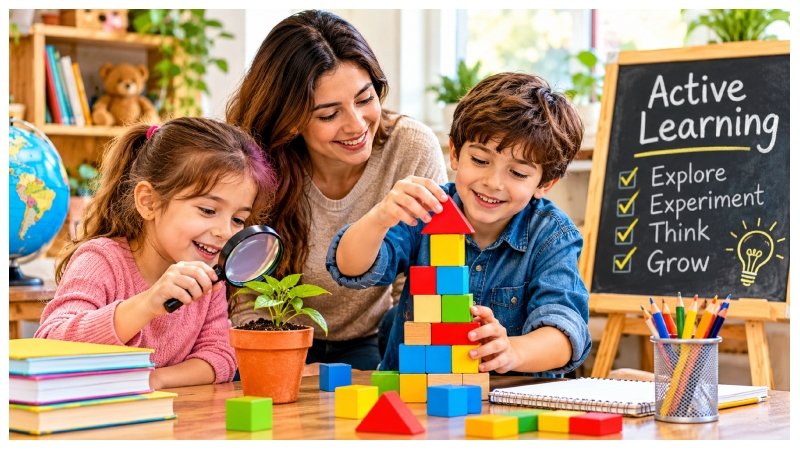
Children do not learn only by reading textbooks or listening to instructions. They develop knowledge and essential life skills when they have opportunities to explore, experiment, ask questions, and discover things independently. From building a tower with blocks to planting seeds in a garden, everyday experiences can become valuable learning opportunities. The Active Learning Guide Fparentips explores practical ways parents can make education more interactive, enjoyable, and meaningful. Instead of depending entirely on traditional teaching methods, families can encourage children to participate in activities that develop curiosity, creativity, critical thinking, and independence.
Active learning does not require expensive equipment, complicated lesson plans, or professional teaching experience. Parents can introduce it through simple household tasks, outdoor adventures, creative projects, educational games, and thoughtful conversations. The key is to create an environment where children feel comfortable asking questions, making mistakes, and trying new ideas.
This guide explains how active learning works, why it matters, and how parents can introduce age-appropriate activities that support children’s development at home.
What Is Active Learning and How Does It Work?
Active learning is an educational approach in which children participate directly in the process of gaining knowledge. Rather than simply receiving information, they interact with ideas, materials, people, and their surroundings to understand how things work.
For example, a child learning about measurements could memorize numbers from a textbook. However, measuring ingredients while helping prepare a simple recipe provides a practical experience that connects mathematics with everyday life.
Similarly, children studying nature can learn more through observing plants, examining leaves, and watching how seeds develop than through passive reading alone.
Active learning commonly involves:
- Exploration: Allowing children to investigate objects, environments, and unfamiliar ideas.
- Experimentation: Giving them opportunities to test possibilities and observe results.
- Problem-solving: Encouraging children to find solutions rather than immediately providing answers.
- Communication: Helping them explain discoveries, ask questions, and share opinions.
- Reflection: Discussing what happened, what worked, and what could be improved.
These experiences help children connect new information with previous knowledge. They also make learning more meaningful because children can understand how concepts apply to real situations.
Why Active Learning Is Important for Children’s Development
Childhood is an important period for developing intellectual, emotional, social, and physical abilities. Interactive experiences give children opportunities to practice these skills in different environments.
Research on play-based learning also supports the value of appropriately guided activities in early education. The effectiveness of an activity depends on its purpose, the child’s developmental stage, and the quality of adult guidance.
Strengthens Critical Thinking and Problem-Solving
Critical thinking helps children examine situations, understand relationships, and make informed decisions.
Parents can introduce simple challenges that require children to think about possible solutions.
For instance, ask a child to build a stable bridge using suitable construction blocks. If the structure collapses, encourage them to identify the problem and try another design.
The experience teaches children to evaluate results, adjust their approach, and understand that problems can have multiple solutions.
Encourages Creativity and Original Ideas
Creative development involves more than drawing or painting. It includes imagining possibilities, experimenting with different approaches, and expressing personal ideas.
Storytelling, music, crafts, pretend play, and building projects give children opportunities to develop their imagination.
Parents should avoid correcting every detail of a creative activity. Allowing children to make their own decisions helps them develop confidence and originality.
Improves Language and Communication
Interactive activities create natural opportunities for children to practice speaking, listening, reading, and explaining ideas.
Parents can discuss stories, ask children to describe their drawings, or encourage them to explain how they completed a project.
These conversations gradually help children organize their thoughts and communicate more clearly.
Develops Independence and Confidence
Children become more confident when they have opportunities to complete appropriate tasks without constant assistance.
Simple responsibilities such as organizing toys, choosing a book, watering plants, or preparing a basic snack with adult supervision can encourage independence.
Recognizing effort and progress also helps children understand that improvement comes through practice.
Supports Social and Emotional Development
Group activities teach children how to cooperate, share resources, take turns, and respect different opinions.
Playing board games, completing family projects, and participating in group challenges can help children practice these skills.
They also learn how to handle disappointment, manage frustration, and continue working toward a goal.
How Parents Can Create an Active Learning Environment at Home
A home can become an effective learning environment without looking like a traditional classroom. Parents can make small adjustments to everyday routines and provide opportunities for children to explore their interests.
Create a Dedicated Space for Exploration
Consider arranging a small area where children can access suitable learning materials.
It might include:
- Picture books and age-appropriate reading materials.
- Building blocks and simple puzzles.
- Drawing paper, washable colors, and craft supplies.
- Educational board games.
- Child-safe objects for sorting and observation.
Organize materials so children can find and return them easily. Rotate activities occasionally to introduce variety without creating unnecessary clutter.
The purpose is to make exploration accessible and enjoyable.
Use Questions to Encourage Independent Thinking
Instead of explaining every situation immediately, ask questions that help children develop their own understanding.
For example:
- What do you notice about this object?
- Why do you think the plant needs sunlight?
- What might happen if we change this part?
- How could we make this structure stronger?
- Can you think of another way to solve the problem?
Give children enough time to consider their answers. Their explanations may not always be correct, but discussing their reasoning can create valuable learning opportunities.
Turn Household Responsibilities Into Learning Experiences
Daily activities provide practical opportunities to introduce educational concepts.
Cooking can teach counting, measuring, sequencing, and following instructions. Grocery shopping can introduce budgeting, comparison, and basic mathematics.
Laundry can involve matching colors and sorting clothing, while gardening can introduce plant growth, weather, and responsibility.
These activities demonstrate that learning is not limited to books or formal lessons.
Allow Children to Learn Through Mistakes
Mistakes are a natural part of discovery. When a project does not work as expected, parents can help children examine the outcome instead of immediately fixing everything.
For example, if a paper airplane does not fly properly, discuss its shape, folding, and possible adjustments.
Encourage children to experiment again and compare the results.
This approach develops persistence and teaches them to view challenges as opportunities for improvement.
Give Children Meaningful Choices
Allowing children to make age-appropriate decisions can increase their motivation.
They might choose a story, select materials for an art project, decide which puzzle to complete, or suggest an outdoor activity.
These small decisions encourage responsibility and help children recognize their interests.
Best Active Learning Activities for Different Age Groups
Children’s abilities and interests change as they grow. Therefore, parents should select activities that match their child’s development rather than expecting every child to complete the same tasks.
The following activities offer practical starting points.
Activities for Toddlers (1–3 Years)
Toddlers develop through movement, repetition, observation, and sensory experiences. Short activities with simple instructions are generally more suitable than complicated projects.
Useful activities include:
- Block stacking: Provide large, safe blocks and encourage toddlers to build simple towers.
- Color recognition: Help children identify colors using familiar household objects.
- Picture-book exploration: Read illustrated books and ask children to identify animals, people, and everyday items.
- Music and movement: Use songs, clapping, and simple movements to encourage coordination.
- Shape matching: Introduce large, age-appropriate shape sorters.
Adult supervision is essential. Avoid small pieces, sharp objects, and materials that could create choking hazards.
Activities for Preschoolers (3–5 Years)
Preschool children often enjoy imaginative play, creative projects, and activities involving discovery.
Try these ideas:
- Simple color experiments: Mix washable paints or colored water to explore how colors change.
- Nature collections: Observe leaves, flowers, and other safe natural objects.
- Story creation: Ask children to invent characters and describe what happens in their stories.
- Counting games: Count toys, fruits, or objects during everyday routines.
- Seed planting: Plant suitable seeds and observe their development over time.
These activities introduce early mathematics, language, science, and observation skills.
Activities for Children Aged 6–9 Years
Children in this age group can often manage more structured activities that involve instructions, planning, and problem-solving.
Recommended activities include:
- Science experiments: Explore simple concepts such as floating, sinking, and evaporation using safe materials.
- Reading challenges: Encourage children to read short books and explain the main ideas.
- Construction projects: Build bridges, towers, or models using suitable materials.
- Mathematical games: Practice addition, subtraction, and multiplication through games.
- Observation journals: Record weather conditions, plant growth, or interesting discoveries.
Parents can ask children to explain their results, helping them connect observations with what they already know.
Activities for Children Aged 10–12 Years
Older children can benefit from activities that involve research, independent planning, and more complex decision-making.
Consider introducing:
- Independent research: Let children investigate topics that match their interests.
- Creative writing: Encourage short stories, journals, and informative writing projects.
- Budget planning: Use imaginary shopping scenarios to practice comparing prices and managing money.
- Science challenges: Design simple experiments and record observations with appropriate adult supervision.
- Presentation projects: Ask children to explain a subject using drawings, notes, or slides.
These experiences help develop organization, communication, analytical thinking, and responsibility.
Learning Through Play: Making Education Enjoyable
Play is an important part of childhood development because it allows children to explore ideas in a relaxed and engaging environment.
Not every activity needs a formal educational objective. Children can develop useful skills through self-directed play as well as activities guided by parents.
Educational Games and Puzzles
Matching cards, jigsaw puzzles, board games, and building challenges can introduce memory, logical thinking, counting, and decision-making.
Choose games that offer an appropriate level of difficulty. A useful activity should challenge children without making them feel overwhelmed.
Pretend Play and Role-Playing
Pretend play allows children to explore situations through imagination.
A child might create a pretend grocery store, restaurant, hospital, or classroom. Parents can participate by asking questions and introducing simple scenarios.
These activities provide opportunities to practice communication, social interaction, and basic mathematics.
Outdoor Learning and Nature Exploration
Outdoor environments introduce children to natural processes and different surroundings.
During a park visit, children can observe changing weather, identify leaves, examine insects from a safe distance, or compare different plants.
Parents can encourage observation by asking children to describe what they see rather than simply giving explanations.
Art, Music, and Creative Projects
Drawing, painting, crafting, and music provide opportunities to express ideas and experiment with different materials.
For example, parents can ask children to design a poster about their favorite animal or create a story using pictures.
The focus should remain on participation and creativity rather than producing perfect results.
How to Use Technology as a Learning Tool
Digital resources can introduce children to new subjects, provide interactive practice, and support creative projects. However, technology works best when it complements other learning experiences.
Parents can explore:
- Educational applications that match children’s ages and abilities.
- Digital books and interactive storytelling.
- Science demonstrations from reliable educational sources.
- Creative drawing and music applications.
- Supervised research activities.
A few sensible practices can make digital learning more productive.
Choose content carefully: Check whether applications and videos are appropriate for the child’s age and developmental needs.
Participate together: Discuss educational content and ask children what they learned.
Set reasonable boundaries: Make sure screen activities do not interfere with sleep, physical activity, family interaction, or other responsibilities.
Balance digital and physical experiences: Follow screen-time guidance appropriate for the child’s age and make time for outdoor play, reading, and hands-on activities.
Technology should expand learning opportunities rather than become the primary way children spend their free time.
Supporting Children With Different Learning Needs
Every child has individual strengths, interests, and developmental needs. Parents should avoid assuming that one teaching method will work equally well for everyone.
Offering different ways to explore a subject can make learning more accessible.
Use Visual Resources
Pictures, diagrams, maps, demonstrations, and charts can help explain information.
For example, a visual diagram of the water cycle can help children understand how evaporation, condensation, and precipitation are connected.
Include Listening and Discussion
Some children enjoy learning through stories, conversations, music, and verbal explanations.
Reading aloud and discussing interesting subjects can help them develop listening skills and express their ideas.
Provide Hands-On Opportunities
Building models, arranging objects, preparing food, and conducting simple experiments allow children to interact directly with the subject.
Adapt Activities to Individual Abilities
If a task becomes too difficult, divide it into smaller steps or provide suitable assistance.
Children who need additional learning support may benefit from visual instructions, predictable routines, extra practice, or guidance from qualified educators when appropriate.
The goal is to provide meaningful participation without labeling children or limiting their potential.
Common Mistakes Parents Should Avoid When Encouraging Active Learning
Parents generally want to support their children’s progress, but certain approaches can unintentionally make learning stressful.
Expecting Every Child to Progress at the Same Speed
Children develop different skills at different times. Comparing their progress with siblings or classmates can create unnecessary pressure.
Focus on individual improvement and celebrate meaningful achievements.
Turning Every Activity Into a Formal Lesson
Children need opportunities for free play and independent exploration. Constant instructions can reduce enjoyment and discourage creativity.
Allow children to explore without always expecting a specific result.
Giving Answers Too Quickly
When parents immediately solve every problem, children lose opportunities to practice independent thinking.
Offer hints or ask guiding questions before providing a complete explanation.
Overloading Children With Activities
A busy schedule does not automatically produce better learning outcomes.
Provide sufficient time for rest, free play, family interaction, and activities children genuinely enjoy.
Ignoring Children’s Interests
Children are more likely to participate when activities connect with subjects they find interesting.
A child who enjoys animals might enjoy reading animal stories, counting toy animals, drawing wildlife, or observing birds outdoors.
Connecting education with existing interests can make participation more natural.
How Parents Can Track Children’s Learning Progress
Learning progress involves more than grades, test results, or completed worksheets. Parents should also observe how children approach challenges and apply their knowledge.
Several indicators can help families understand development.
Increased curiosity: Children ask questions, investigate unfamiliar subjects, and show interest in new experiences.
Improved problem-solving: They become more comfortable trying different solutions when an activity becomes difficult.
Greater independence: They complete familiar tasks with less assistance and make appropriate decisions.
Better communication: They explain ideas, describe observations, and participate in discussions.
Stronger persistence: They are more willing to continue an activity after making mistakes.
Parents can maintain a simple learning journal containing activities, observations, new skills, and areas where children need additional support.
Reviewing these notes periodically can help families recognize progress and select suitable activities for the future.
A Practical Weekly Active Learning Plan for Families
Busy parents do not need to organize lengthy educational sessions. A flexible weekly routine can provide regular opportunities for children to explore different subjects.
Here is an example that families can adapt according to their schedules.
| Day | Suggested activity | Developmental focus |
|---|---|---|
| Monday | Read and discuss a story | Language and comprehension |
| Tuesday | Complete a puzzle | Logical thinking |
| Wednesday | Plant seeds or observe nature | Science and observation |
| Thursday | Create an art project | Creativity |
| Friday | Play a mathematics game | Numeracy |
| Saturday | Explore a park or outdoor space | Discovery and physical activity |
| Sunday | Discuss weekly experiences | Communication and reflection |
Parents can spend a short, manageable period on each activity and allow children to decide which experiences they enjoy most.
Consistency, encouragement, and flexibility are more important than following a strict schedule.
Frequently Asked Questions About Active Learning
What is the main purpose of active learning?
The main purpose is to involve children directly in the learning process. It encourages them to explore ideas, ask questions, solve problems, and apply knowledge through practical experiences.
How can parents introduce active learning at home?
Parents can begin with simple activities such as reading together, cooking, gardening, drawing, playing educational games, and discussing everyday observations. These experiences introduce useful concepts without requiring expensive resources.
Is active learning suitable for young children?
Yes. Age-appropriate active learning can begin during early childhood through supervised play, sensory exploration, picture books, movement, and simple interactive activities.
Does active learning improve problem-solving skills?
It can support problem-solving by giving children opportunities to identify challenges, test possible solutions, observe results, and adjust their approach.
How much time should children spend on active learning?
There is no single schedule suitable for every child. Parents can introduce short activities according to age, attention span, interests, and daily routines. Children also need sufficient time for free play and rest.
Can technology be included in active learning?
Yes. Educational applications, digital books, interactive demonstrations, and supervised research can support learning. However, digital resources should complement hands-on activities, physical play, and family interaction.
Final Thoughts
Active learning gives children opportunities to develop knowledge and important life skills through exploration, participation, and real-world experiences. It helps make education more engaging while encouraging curiosity, creativity, independence, communication, and problem-solving. Click here for more information.
The Active Learning Guide Fparentips demonstrates that parents do not need complicated teaching methods or expensive educational materials to support meaningful development. Everyday activities, family conversations, outdoor exploration, and creative play can all become valuable learning experiences.
The most important step is to understand each child’s interests, provide age-appropriate opportunities, and create an environment where asking questions and making mistakes are welcomed.
When parents focus on encouragement rather than perfection, children can develop a healthier relationship with learning and become more confident in exploring the world around them.