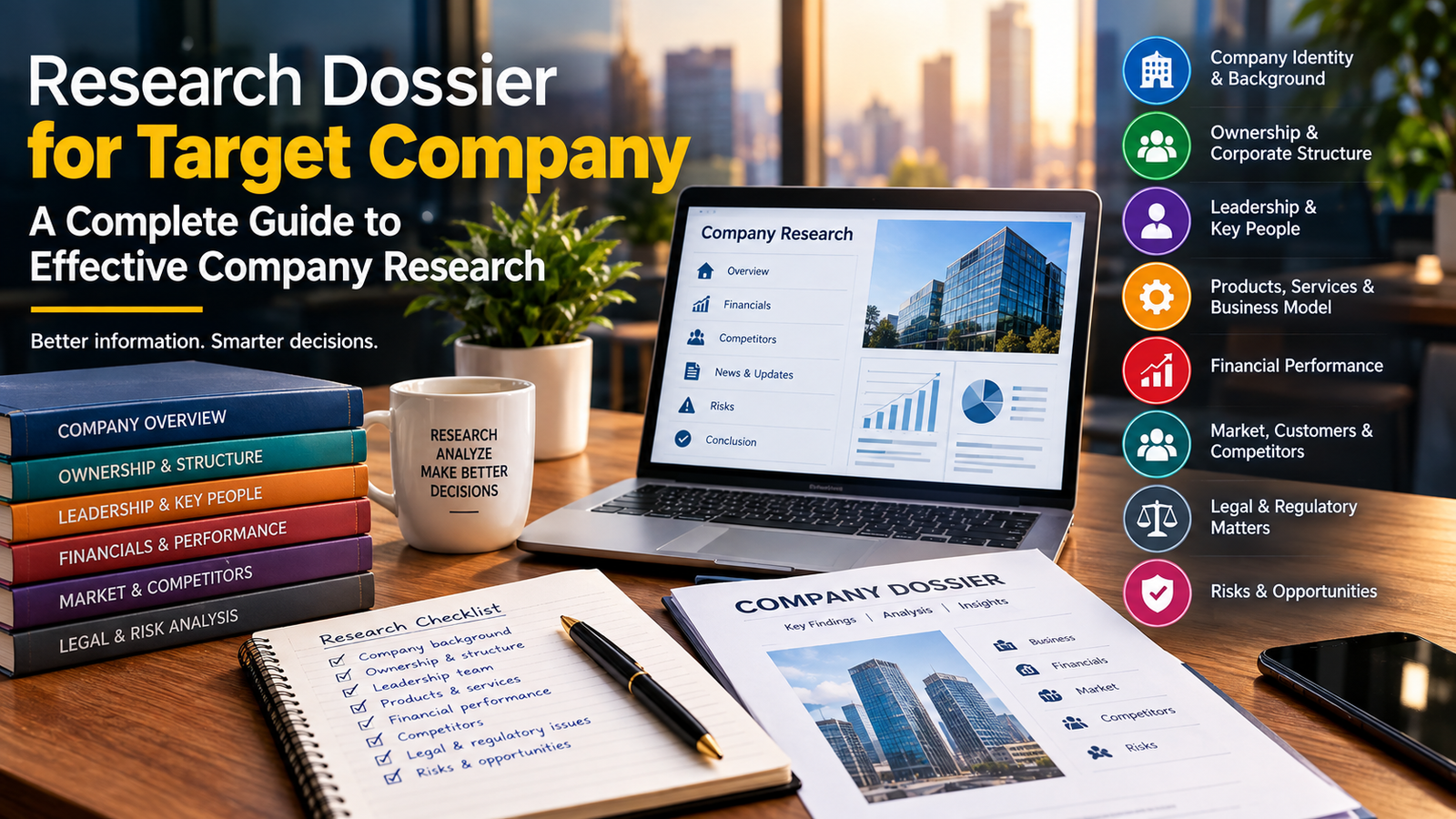
A company can look impressive from its website, social media profiles, and marketing materials. But those sources rarely tell the whole story. If you need to understand a business before working with it, competing against it, investing in it, acquiring it, or conducting due diligence, you need a more structured approach. A research dossier for target company brings relevant business information into one organized record. It can combine corporate details, ownership, leadership, financial information, market activity, competitors, legal matters, reputation, and potential risks.
The value of a dossier does not come from its length. It comes from the quality of its sources, the accuracy of its findings, and the clarity with which facts and analysis are presented.
What Is a Research Dossier for a Target Company?
A research dossier is a structured research file created to develop a detailed understanding of a specific company.
It goes beyond a basic company description. Instead of simply repeating information published by the business, a well-prepared dossier examines information from multiple sources and records evidence behind important findings.
Depending on the purpose of the research, it may cover:
- Company history and corporate identity
- Ownership and subsidiaries
- Executives and board members
- Products and services
- Business model
- Financial performance
- Customers and markets
- Competitors
- Legal and regulatory matters
- Intellectual property
- Reputation
- Major developments
- Potential risks
- Research gaps and uncertainties
The final document can be a few pages for preliminary research or much more detailed when it supports formal due diligence.
Why Is a Company Research Dossier Important?
Businesses make decisions with incomplete information all the time. A structured research process helps reduce that problem.
It Creates a Central Source of Information
Instead of searching through dozens of browser tabs, reports, articles, and databases, important findings can be organized in one place.
It Reveals More Than Marketing Material
Official company information is useful, but it naturally presents the business from its own perspective. Independent sources can provide additional context.
It Helps Identify Questions Early
Research may uncover ownership changes, declining financial results, regulatory issues, unusual corporate structures, or other matters that deserve closer examination.
It Makes Comparisons Easier
Using the same research categories for multiple companies creates a more consistent basis for competitor or market analysis.
It Supports Due Diligence
A research dossier is not a substitute for professional legal or financial due diligence, but it can help identify areas that deserve further investigation.
What Should a Target Company Dossier Include?
The exact structure should match the research objective. However, several sections are useful in most investigations.
1. Company Identity and Background
Begin by establishing exactly which company you are researching.
Record details such as:
- Legal name
- Trading name
- Website
- Headquarters
- Countries or regions of operation
- Industry
- Founding date
- Registration information where available
- Parent company
- Subsidiaries or related entities
This step is more important than it may seem. Businesses can have similar names, multiple subsidiaries, or different legal entities operating under one brand.
2. Ownership and Corporate Structure
Next, investigate who owns or controls the business.
Depending on the company, relevant information may include shareholders, founders, parent organizations, institutional investors, subsidiaries, acquisitions, and major ownership changes.
Public companies often provide ownership information through regulatory filings. Private-company information can be harder to verify, so the dossier should clearly identify what is confirmed and what remains unavailable.
3. Leadership and Key People
Identify the people responsible for managing the organization.
Research:
- Chief executive or managing director
- Founders
- Board members
- Senior executives
- Relevant professional backgrounds
- Leadership changes
- Previous roles where independently verifiable
Leadership information should be dated because executives can change positions after a company publishes an older profile.
4. Products, Services, and Business Model
Understanding what a company sells is only the beginning.
Try to determine how the business actually makes money.
Consider:
- Main products or services
- Primary customer groups
- Pricing or subscription model where publicly available
- Distribution channels
- Geographic markets
- Recurring versus one-time revenue
- Major business segments
- Dependence on particular products or customers
For example, a software company with subscription revenue should be analyzed differently from a manufacturer that depends on physical production and distribution.
5. Financial Performance
Financial information can provide important context about a company’s condition and direction.
For public companies, researchers can examine annual reports, quarterly filings, earnings releases, investor presentations, and other regulatory disclosures.
Relevant areas may include:
- Revenue
- Profit or loss
- Operating expenses
- Cash flow
- Cash reserves
- Debt
- Assets and liabilities
- Segment performance
- Year-over-year changes
Always attach a date or reporting period to financial information.
A revenue figure from an earlier fiscal year should not be presented as if it describes the company’s current performance.
For private companies, detailed financial data may not be publicly available. A credible dossier should acknowledge that limitation rather than estimate figures without adequate evidence.
6. Market and Industry Analysis
A target company exists within a wider market.
Research the industry in which it operates and consider factors such as:
- Market size
- Customer demand
- Industry growth or contraction
- Major competitors
- Regulatory developments
- Technology changes
- Supply-chain conditions
- Barriers to entry
Market-share figures deserve particular scrutiny. Different research firms may define the market differently, use different periods, or measure different geographic regions.
7. Competitor Landscape
Identify both direct and indirect competitors.
Direct competitors offer similar products or services to similar customers. Indirect competitors may solve the same customer problem through a different approach.
A useful comparison might examine:
| Research Area | Target Company | Competitor |
|---|---|---|
| Core offering | Main product/service | Main product/service |
| Customer segment | Primary audience | Primary audience |
| Geographic reach | Main markets | Main markets |
| Business model | Revenue structure | Revenue structure |
| Differentiation | Evidence-based strengths | Evidence-based strengths |
| Major risks | Documented concerns | Documented concerns |
The objective is not to declare a winner. It is to understand how the companies operate and where their business models differ.
8. Legal and Regulatory Research
Legal and regulatory information can be particularly important when assessing a company.
Depending on the jurisdiction and industry, investigate:
- Court records
- Regulatory enforcement
- Corporate registrations
- Licenses
- Compliance matters
- Intellectual-property disputes
- Material lawsuits
- Government actions
A media report may help you discover a legal matter, but the underlying court or regulatory record is generally more useful for verification.
Be precise with terminology. An allegation, complaint, investigation, settlement, judgment, and conviction are not interchangeable.
9. Technology and Intellectual Property
For technology-driven companies, this section can be critical.
Depending on the business, investigate:
- Patents
- Trademarks
- Proprietary technology
- Software platforms
- Research and development
- Licensing arrangements
- Intellectual-property disputes
Not every company needs extensive technical research. The depth should reflect how important technology and intellectual property are to its business model.
10. Customers and Market Reputation
A company’s public reputation can provide useful context, but it needs to be researched carefully.
Consider:
- Customer feedback
- Industry publications
- Independent reporting
- Regulatory announcements
- Public company responses
- Major customer relationships where reliably disclosed
Online reviews can reveal recurring themes, but individual reviews should not automatically be treated as representative of the entire customer base.
The same principle applies to social media. It can identify issues worth investigating, but important conclusions should be supported by stronger evidence.
How to Build a Research Dossier Step by Step
A repeatable process can make company research faster and more reliable.
Define the Purpose of the Research
Start by asking why the company is being investigated.
Possible objectives include:
- Competitor research
- Supplier evaluation
- Partnership assessment
- Investment research
- Acquisition preparation
- Market analysis
- Customer or vendor screening
- Preliminary due diligence
The purpose determines what information deserves the most attention.
Confirm the Company’s Identity
Before collecting data, verify that every source refers to the correct business.
Check the company’s:
- Legal name
- Website
- Location
- Registration details
- Parent organization
- Industry
This prevents one of the most basic research errors: combining information belonging to different businesses with similar names.
Build a Source Hierarchy
Not every source has the same evidentiary value.
A practical hierarchy is:
Primary sources: regulatory filings, government records, court documents, official financial reports, and company disclosures.
Reliable secondary sources: established news organizations, respected industry publications, and credible research organizations.
Discovery sources: search results, directories, forums, social media, and user-generated content.
Discovery sources can help you find leads, but important claims should be checked against stronger evidence.
Collect Information by Category
Do not research randomly.
Create sections for company identity, ownership, management, finances, operations, market position, competitors, legal matters, and reputation.
This reduces duplication and makes missing information easier to identify.
Record the Evidence
For every significant claim, maintain a simple evidence log.
| Claim | Source | Date | Verification | Notes |
|---|---|---|---|---|
| Leadership position | Official source | Date | Confirmed | Check current status |
| Revenue figure | Financial filing | Date | Confirmed | Reporting period noted |
| Legal matter | Court record | Date | Confirmed | Status documented |
| Market claim | Industry source | Date | Needs context | Methodology reviewed |
This small step can dramatically improve the quality of the final dossier.
Cross-Check Important Claims
If a fact matters to your conclusion, look for independent confirmation.
For example, a company may describe itself as a market leader. Instead of repeating that statement, investigate whether credible industry data supports the claim and determine how “market leader” was defined.
When sources disagree, document the difference.
Do not simply choose the number or statement that supports a preferred conclusion.
Separate Facts, Claims, and Analysis
This is one of the most important principles of professional research.
Documented fact: A company’s filing reported a specific revenue figure for a defined period.
Company claim: The company describes its product as a market-leading solution.
Research analysis: The available evidence suggests the company’s revenue changed during the reported period, which may justify further investigation.
Keeping these categories separate prevents assumptions from being presented as established facts.
Identify Information Gaps
Good research does not pretend to know everything.
A private company may not disclose detailed financial statements. Ownership records may be incomplete in some jurisdictions. Older news reports may no longer reflect current circumstances.
Record these limitations.
Knowing what cannot be verified is itself useful research information.
Prepare the Executive Summary Last
Once the research is complete, summarize the most important findings.
A strong executive summary should answer:
- What does the company do?
- Who owns or controls it?
- What markets does it serve?
- What are its major business characteristics?
- What important developments were identified?
- What risks or unanswered questions deserve further review?
Writing this section last ensures that it reflects the evidence collected throughout the research.
How to Judge the Quality of Your Sources
Before adding information to a dossier, ask five questions:
Is the source authoritative?
A government filing generally carries more evidentiary weight than an anonymous online post.
Is it current?
Leadership, ownership, financial results, and legal matters can change.
Is it specific?
Make sure the source actually refers to the company under investigation.
Is the information independently supported?
Important claims are stronger when multiple credible sources support them.
Is the context clear?
A statistic without its date, geography, methodology, or reporting period can be misleading.
Common Mistakes in Company Research
Relying Entirely on the Company’s Website
Official websites are valuable starting points, but they usually present the company from its own perspective.
Treating Search Snippets as Evidence
Search results help locate information. They should not replace reviewing the underlying source.
Using Outdated Information
An old executive biography or historical financial figure can create a misleading picture of the current company.
Mixing Facts With Opinions
A research dossier should make it clear when something is an established fact, a company statement, an allegation, or the researcher’s interpretation.
Ignoring Contradictory Evidence
If credible sources disagree, document the disagreement and investigate why.
Overloading the Dossier With Irrelevant Information
More pages do not necessarily mean better research. Information should serve the research objective.
Failing to Record Sources
Without an evidence trail, readers may struggle to verify important claims later.
Research Dossier vs. Company Profile
A company profile and a research dossier serve different purposes.
A company profile generally provides a concise overview of a business, including its history, products, services, locations, and leadership.
A research dossier is broader and more investigative. It can examine ownership, financial performance, competitors, legal matters, market conditions, reputation, risks, evidence quality, and information gaps.
A profile answers:
“What is this company?”
A dossier goes further by asking:
“What can reliable evidence tell us about this company, its position, and the questions that still need investigation?”
A Practical Research Dossier Template
You can use the following structure as a starting point:
- Research objective
- Research date
- Company identification
- Executive summary
- Company history
- Ownership and corporate structure
- Leadership and key personnel
- Products and services
- Business model
- Financial information
- Customers and target markets
- Industry analysis
- Competitor analysis
- Legal and regulatory matters
- Technology and intellectual property
- Reputation and public information
- Key developments
- Potential risks
- Information gaps
- Evidence and source log
Not every investigation requires every section. Remove categories that have no relevance to the research objective and expand the areas that matter most.
Final Takeaway
A useful research dossier for target company is not simply a long collection of company facts. It is a structured investigation built around a clear purpose, reliable sources, verifiable evidence, and transparent analysis.
Start by identifying the correct company and defining your research objective. Then examine its ownership, leadership, operations, financial position, market, competitors, legal environment, and reputation. Record sources as you work, verify important claims, distinguish facts from opinions, and clearly document information that cannot be confirmed. Click here for more information.
The result is a research document that is easier to review, update, compare, and use when deeper business investigation is required.