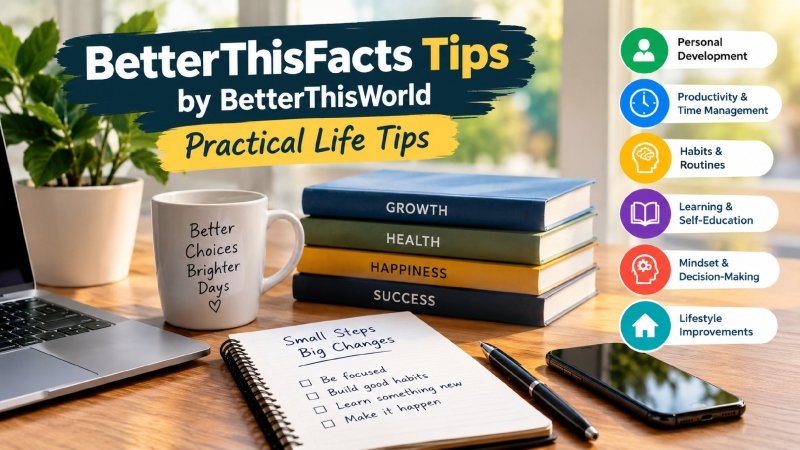
Finding useful advice online is easy, but knowing which ideas deserve your attention can be much harder. BetterThisFacts tips by BetterThisWorld focuses on practical knowledge, useful facts, personal growth, and everyday ideas that can encourage smarter choices. Rather than collecting endless advice, readers can benefit more by understanding useful concepts, checking important information, and applying realistic changes.
Topics may include productivity, habits, learning, mindset, decision-making, and everyday lifestyle improvements. The goal is simple: turn useful information into actions that can make daily life more organized and purposeful.
What Are BetterThisFacts Tips by BetterThisWorld?
BetterThisFacts tips can be understood as practical ideas and information connected with personal improvement and everyday living.
Common areas include:
- Personal development
- Productivity and time management
- Habits and routines
- Learning and self-education
- Mindset and decision-making
- Everyday lifestyle improvements
- Digital habits and information awareness
- Practical life lessons
One important distinction should always be kept in mind: advice and facts are not necessarily the same thing. A personal recommendation may be useful without being a proven fact, while a factual claim should have suitable evidence behind it.
Understanding this difference helps readers become more careful when consuming information online.
Why Practical Tips Matter
Meaningful improvement does not always require complicated systems. Simple actions can sometimes produce better results when they are repeated consistently.
For instance, planning the next day’s priorities before going to bed may make a busy morning easier. Reducing unnecessary notifications can also create fewer interruptions during focused work.
What matters most is not how impressive a tip sounds. Its real value comes from whether it can be applied and maintained in everyday life.
Start With Small, Realistic Changes
Trying to change everything at once can make personal improvement unnecessarily difficult.
A more practical approach is to select one behavior and make it manageable. Someone who wants to read more could begin with 10 or 15 minutes a day rather than setting an unrealistic target.
Small actions are easier to repeat. Over time, repetition can help turn a new behavior into a consistent routine.
A simple approach
Choose one improvement and practice it for the next seven days. Keep the action simple enough that it fits naturally into your normal schedule.
Check Information Before Trusting It
Online information can spread quickly, but popularity does not guarantee accuracy.
A viral post, dramatic headline, or attractive infographic may leave out important context. Before relying on a claim, consider where it originated and whether credible evidence supports it.
For important topics, check:
- Who published the information
- When it was published
- Whether an original source is available
- What evidence supports the claim
- Whether reliable independent sources agree
Extra care is particularly important with health, financial, legal, safety, and scientific information.
A widely shared claim is not automatically a verified fact.
Protect Your Attention
Phones and digital platforms make distraction incredibly easy.
Notifications, social feeds, messages, and constant updates can interrupt concentration throughout the day. Instead of removing technology completely, create reasonable boundaries around its use.
Silencing nonessential notifications or keeping your phone away during focused work can make it easier to concentrate.
Ultimately, the goal is to decide where your attention goes rather than letting every notification make that decision for you.
Set Clear Daily Priorities
A long task list can create the feeling of productivity without showing which activities actually matter.
Try selecting three important tasks at the beginning of the day. Consider which responsibility has the greatest impact and which deadline genuinely requires attention.
Starting with the highest-priority task can make the rest of the day easier to manage.
At the same time, leave some space for unexpected work. A schedule with no flexibility can quickly become stressful when plans change.
Connect New Habits to Existing Routines
Remembering a new habit becomes easier when it is connected to something you already do.
For example:
- Read after your morning tea or coffee.
- Review priorities after starting work.
- Prepare tomorrow’s tasks before shutting down your computer.
- Take a short walk after a regular daily activity.
This approach reduces the need for constant reminders.
A good habit system does not have to look impressive. It simply needs to work with your actual lifestyle.
Make Learning Part of Your Routine
Continuous learning can improve your knowledge without requiring several hours every day.
Books, reputable articles, educational courses, practical projects, and knowledgeable people can all provide opportunities to learn.
However, consuming information is not the same as understanding it. After learning something useful, ask yourself how that knowledge could be applied.
Writing down one important lesson or testing it in a real situation can make the learning experience more valuable.
Improve Your Decision-Making
Better decisions often begin with better questions.
When facing an important choice, take a moment before reacting to the first piece of information available.
Ask yourself:
What do I actually know?
Separate verified information from assumptions.
What might I be missing?
Think about information that could change your conclusion.
What could happen next?
Consider both short-term and longer-term consequences.
Are there alternatives?
The first available option is not necessarily the best one.
Taking this extra step can encourage more thoughtful decisions.
Adapt Advice to Your Own Situation
Online advice is often presented as though one method works for everybody. Real life is more complicated.
People have different schedules, responsibilities, resources, goals, and preferences. An early-morning routine might work well for one person but be impractical for someone who works late.
Use general advice as a starting point rather than an absolute rule. The most useful approach is one that fits your circumstances and can be maintained over time.
Make Room for Rest
Personal improvement should not mean being productive every minute.
Sleep, breaks, recreation, time away from screens, and other forms of rest can help create a more sustainable routine.
A routine that constantly leaves you exhausted may need adjustment. Sustainable progress is generally more useful than an extreme plan that lasts only a few days.
Review Your Progress Regularly
You do not need an elaborate tracking system to understand whether a new habit is helping.
Once a week, ask:
- What worked well?
- What did not work?
- Which habit was easiest to maintain?
- What created unnecessary difficulty?
- What should I change next week?
This turns personal development into an ongoing learning process rather than a collection of rigid goals.
How to Apply BetterThisFacts Tips in Everyday Life
A simple framework is:
Understand → Verify → Apply → Review
Understand
Read the advice carefully and make sure you understand what it actually recommends.
Verify
For important or consequential claims, check trustworthy and appropriate sources instead of depending on one online post.
Apply
Test the idea in a realistic way. Starting with one or two changes is usually easier than attempting a complete lifestyle transformation.
Review
After giving the idea enough time, consider whether it produced a useful result. Keep what works and adjust what does not.
This process helps turn online information into practical action.
Common Mistakes to Avoid
Even good advice can become ineffective when it is used without context.
Changing everything overnight can create unnecessary pressure and make consistency difficult.
Constantly searching for new tips may become a distraction from practicing the advice you already have.
Ignoring personal circumstances can lead to routines that are unrealistic or difficult to maintain.
Confusing opinions with facts can result in poor decisions, especially when information is presented confidently.
Expecting instant results can also lead to unnecessary frustration. Most useful habits need time and repetition.
A Simple 7-Day Improvement Challenge
A short challenge can help turn these ideas into action.
Day 1: Choose one habit you want to improve.
Day 2: Remove one unnecessary distraction.
Day 3: Spend 15 minutes learning something useful.
Day 4: Verify one interesting claim instead of immediately believing or sharing it.
Day 5: Identify your three most important tasks.
Day 6: Review what worked during the week.
Day 7: Keep the habits that felt realistic and remove unnecessary complexity.
The purpose is not to completely transform your life in one week. Instead, use the challenge to discover which small actions are practical enough to continue.
Final Thoughts
The real value of BetterThisFacts tips by BetterThisWorld is not simply collecting more facts or following every piece of advice you encounter. Click here for more details.
Useful knowledge becomes more valuable when it leads to better decisions and practical action. Start with manageable changes, verify important claims, protect your attention, and choose habits that fit your circumstances.
You do not need a perfect routine to make progress. Pick one useful idea, put it into practice, learn from the experience, and gradually build from there.