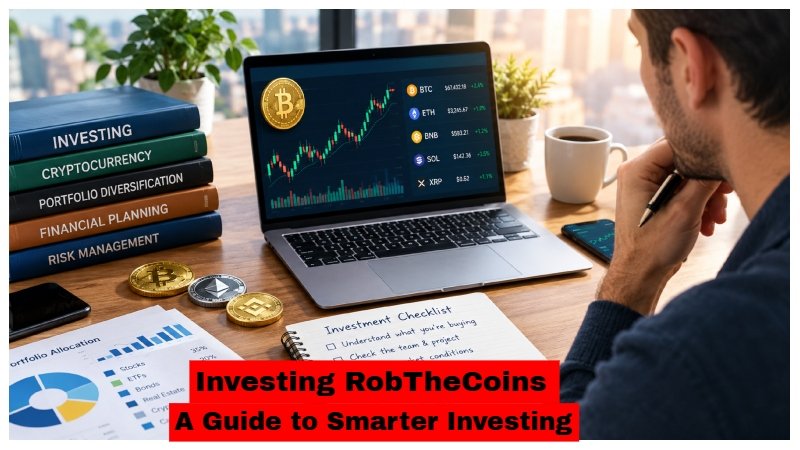
Investing RobTheCoins is a search term for people looking to understand investment-related information, cryptocurrency, and financial strategies associated with the RobTheCoins name. Before acting on any information, it is important to understand what RobTheCoins actually offers, how to evaluate investment opportunities, and which risks deserve attention. A useful investment decision starts with research and verification, not promises of quick profits.
Whether you are a beginner exploring financial markets or an experienced investor researching digital assets, learning how to assess financial information can help you make more informed decisions. Stocks, exchange-traded funds (ETFs), bonds, real estate, and cryptocurrencies all have different characteristics, costs, and risks. Understanding these differences is essential when building a financial plan.
This guide explains what Investing RobTheCoins means, how to evaluate its investment-related content, which cryptocurrency risks to consider, and how to develop a more disciplined approach to financial decisions.
What Is Investing RobTheCoins?
The phrase Investing RobTheCoins can refer to investment-related information published under the RobTheCoins name. The RobTheCoins.com website has an Investing category covering subjects such as investor psychology, portfolio diversification, investing apps, alternative assets, and financial decision-making.
However, an investment information website and an investment service are not necessarily the same thing. Publishing articles about cryptocurrency or financial markets does not automatically mean a website operates a brokerage, manages customer portfolios, holds digital assets, or offers a cryptocurrency for purchase.
Readers should therefore identify the exact website and service they are researching before sharing personal information or transferring money.
When exploring RobTheCoins investing content, consider three important questions:
- What information does the website provide? Determine whether the page offers educational explanations, market commentary, product reviews, or specific investment recommendations.
- What evidence supports its claims? Look for reliable sources, transparent explanations, and information that can be independently verified.
- Is a financial service actually being offered? If a page directs you to an app, trading account, wallet, or investment opportunity, investigate that separate service before proceeding.
These distinctions help prevent confusion between learning about investments and entrusting money to a financial provider.
What Can You Learn From RobTheCoins Investing Content?
Investment education can help readers understand unfamiliar financial concepts, identify relevant questions, and compare different approaches to managing money.
RobTheCoins’ published investing category covers a range of subjects rather than one narrowly defined investment strategy. Topics include trading psychology, diversification beyond cryptocurrency, investment applications, copper, land, and other financial matters.
This variety can provide useful starting points for further research. However, readers should evaluate each article individually because the quality, evidence, and relevance of financial information can vary.
Understanding Investor Psychology
Investment decisions are influenced by emotions, memories, and expectations. For example, an investor who remembers several successful trades may become overconfident and increase the amount invested without properly evaluating the risks.
This is one reason keeping a record of financial decisions can be useful. Write down why you considered an investment, what evidence supported the decision, and which circumstances would cause you to reconsider it.
Reviewing both successful and unsuccessful decisions provides a more balanced picture than remembering only the outcomes that went well.
Exploring Diversification
Diversification involves spreading investments across different assets or market segments instead of relying too heavily on one holding.
For example, an investor who owns only one cryptocurrency is exposed to the fortunes of that particular asset. A diversified portfolio may reduce dependence on a single investment, although it cannot eliminate market losses.
The appropriate level of diversification depends on financial goals, time horizon, risk tolerance, and individual circumstances.
Learning About Different Asset Classes
Investment articles can introduce readers to assets they have not previously considered, including stocks, bonds, ETFs, real estate, and commodities.
Rather than selecting an asset because it appears attractive in an article, use the information as a starting point. Research how the asset works, what influences its value, and whether it fits your financial objectives.
How to Evaluate Investment Opportunities Before Committing Money
One of the most important investing skills is knowing how to evaluate an opportunity independently. A persuasive headline or attractive return forecast is not enough to establish that an investment is suitable.
Use the following process before making a financial commitment.
Understand What You Are Buying
Begin by identifying the exact investment. If you are considering a stock, research the company and how its business generates revenue. For an ETF, examine the fund’s holdings, objective, expenses, and risks.
For cryptocurrency, investigate the project’s purpose, token supply, technology, and potential uses.
If someone offers an investment product through a website using the RobTheCoins name, determine which legal entity provides it and what contractual rights you would receive. Do not assume that a publisher and a separately promoted financial service are operated by the same organization.
Verify Important Claims
Financial claims should be supported by evidence that readers can check independently.
Company information may be available through financial statements and regulatory filings. ETF details can be checked against official fund documentation. Cryptocurrency projects may publish technical documentation, supply information, and security disclosures.
Compare important claims across multiple credible sources. Be cautious when a page relies mainly on testimonials, anonymous endorsements, or unsupported statements about future prices.
Examine Potential Losses
Before considering how much money an investment might make, consider how much you could lose.
Ask what might happen if the company performs poorly, interest rates change, a cryptocurrency loses market demand, or the market enters a prolonged downturn.
A realistic assessment includes unfavorable outcomes rather than focusing exclusively on the best-case scenario.
Understand Fees and Liquidity
Fees can reduce the amount you ultimately receive from an investment. Depending on the product, these may include transaction charges, management fees, withdrawal fees, or other expenses.
Liquidity matters as well. An investment may be difficult to sell quickly, particularly when trading activity is limited. A quoted market price does not guarantee that you can sell your entire position at that price.
Understanding these factors before investing can help you avoid unexpected costs and access problems.
Understanding Cryptocurrency Investing and Its Risks
Cryptocurrency attracts investors interested in digital assets and blockchain technology. However, digital assets can behave differently from traditional investments, and their prices may change significantly over short periods.
Some cryptocurrency projects aim to support payments, decentralized applications, or other blockchain-based activities. Others may have limited practical use or depend heavily on speculative demand.
Before considering a cryptocurrency, examine the following factors.
Project Purpose and Utility
Understand what the project is intended to accomplish and whether its proposed use is clearly explained.
Look beyond promotional statements. Consider whether the technology addresses a genuine problem, whether its claimed features can be verified, and whether there is credible evidence of adoption.
A complicated technical description does not automatically indicate a valuable project.
Token Supply and Ownership
Token supply can influence how a cryptocurrency behaves in the market. Research the circulating supply, maximum supply if applicable, future issuance, and distribution among major holders.
A project with concentrated ownership may face different risks from one with more widely distributed holdings. Large holders may be able to influence market prices, particularly in less liquid markets.
These details are useful for assessing risk, but none can reliably predict future prices on its own.
Security and Asset Storage
Digital assets can be exposed to phishing attacks, fraudulent websites, compromised wallets, exchange failures, and stolen credentials.
Protect private keys and wallet recovery phrases. Never disclose them to someone claiming to provide investment assistance. Verify website addresses and wallet destinations carefully before approving transactions.
If a third-party provider holds your assets, understand its custody arrangements, withdrawal conditions, and potential consequences if the provider becomes insolvent.
Volatility and Liquidity
Cryptocurrency prices can rise or fall sharply as market sentiment, regulations, technology, and trading activity change.
Smaller tokens may be especially vulnerable to limited liquidity. Even when a token displays a particular price, buyers may not be available to purchase a large position at that level.
For these reasons, cryptocurrency should not automatically be treated as a substitute for emergency savings or money needed for essential expenses.
RobTheCoins Website Verification: What Readers Should Check
Because similar names can appear across different domains, identifying the exact website is an important part of researching Investing RobTheCoins.
A website’s name, logo, or description is not sufficient proof of its ownership, services, or regulatory status. Before relying on any investment-related service, carry out these checks.
Check the exact domain. Confirm the complete website address and watch for misspellings or lookalike domains. A page on one domain should not automatically be treated as an official page of another website using a similar name.
Read the About and Contact pages. Look for information about the organization, its purpose, its editorial approach, and how readers can contact it. Treat these details as starting points for verification rather than conclusive proof of legitimacy.
Check financial service claims. If a website claims to be licensed, registered, or regulated, identify the relevant regulator and verify the legal entity and authorization independently. The appropriate register depends on the service and jurisdiction.
Review the terms and privacy policy. If an actual financial product is offered, understand its fees, withdrawal conditions, data practices, and the risks described in its terms.
Investigate promotional relationships. Some websites earn money through advertisements, affiliate links, or referrals. Where these relationships exist, consider whether the financial interest is clearly disclosed and whether it could influence the information presented.
The key principle is straightforward: verify the specific service you intend to use instead of relying on assumptions based on its name.
Investing RobTheCoins: Educational Information Versus Financial Advice
Investment content can help readers understand markets, but general educational information is not the same as personalized financial advice.
An educational article might explain how diversification works or describe the risks associated with a particular asset class. Personalized advice, by contrast, considers factors such as income, debt, investment objectives, time horizon, tax circumstances, and risk tolerance.
A strategy that suits one investor may be inappropriate for another.
For example, a person saving for a major expense next year may have less capacity to tolerate a substantial market decline than someone investing for a goal several decades away. Similarly, an investor with significant existing debt may need to prioritize financial stability before taking additional market risk.
Use investment articles to build your understanding and identify questions worth researching. When a decision involves substantial savings, complex financial products, or significant tax consequences, consider consulting a qualified professional.
Practical Investment Strategies for Better Decisions
A sensible investment process does not require constant trading or complicated predictions. Consistent habits can make it easier to evaluate opportunities and manage uncertainty.
Set Clear Financial Goals
Define what you want your money to achieve. Your objective might be long-term wealth building, retirement planning, saving for a purchase, or learning how financial markets operate.
Give each goal a realistic time horizon. This helps determine how much market risk you may be able to accept and how accessible the money needs to remain.
Establish Financial Priorities
Before investing, consider essential expenses, high-interest debt, and emergency savings. Investing money that you may need immediately can force you to sell at an unfavorable time.
The amount available for investment should reflect your overall financial position rather than an arbitrary percentage promoted online.
Diversify Thoughtfully
Consider how each investment contributes to your overall portfolio. Holding several assets does not necessarily create meaningful diversification if they all depend on the same market conditions.
For example, owning multiple cryptocurrencies with similar risk characteristics may still leave a portfolio heavily exposed to the digital asset market.
Diversification can reduce concentration risk, but it cannot guarantee profits or prevent every loss.
Review Decisions Periodically
Set a reasonable schedule to review your investments and financial goals. Record why you made each decision and whether the original reasoning remains valid.
Avoid changing strategies every time a market headline appears. A consistent review process can help you distinguish meaningful developments from short-term noise.
Common Investment Mistakes to Avoid
Even carefully researched investments can lose money. However, avoiding common behavioral mistakes can help reduce unnecessary risks.
Following hype without research: Popularity on social media does not establish that an investment has strong fundamentals or a sustainable future.
Believing guaranteed-return promises: Claims of guaranteed profits or risk-free high returns deserve serious scrutiny. Legitimate investments involve uncertainty, and losses are possible.
Investing essential savings: Money needed for bills, emergencies, or near-term commitments should not be exposed casually to volatile investments.
Ignoring the possibility of fraud: Unsolicited investment offers, pressure to deposit quickly, and requests for additional payments to unlock supposed profits are warning signs.
Overlooking fees and taxes: Transaction costs, management charges, and applicable taxes can affect your actual financial outcome.
Letting emotions control decisions: Fear of missing out may encourage rushed purchases, while panic can lead to poorly timed sales. A written plan provides a framework for evaluating decisions more consistently.
Assuming past performance predicts future results: A strong historical return does not guarantee continued growth. Market conditions and the underlying investment can change.
Recognizing these mistakes is useful whether you are researching RobTheCoins content, studying cryptocurrency, or evaluating traditional financial products.
A Pre-Investment Checklist for RobTheCoins Readers
Before acting on an investment idea found online, use this checklist to identify gaps in your research.
-
I have identified the exact asset or financial service.
-
I understand how the investment could generate a return.
-
I have reviewed the major risks and potential losses.
-
I have checked important claims against independent sources.
-
I understand the fees, liquidity, and withdrawal conditions.
-
I have verified the provider’s identity and relevant regulatory claims.
-
I can afford the potential loss without compromising essential expenses.
-
I am not relying on guaranteed-return promises or pressure to act quickly.
-
The investment fits my financial goals and time horizon.
If you cannot confidently answer these questions, pause and conduct more research before committing money.
Frequently Asked Questions
What Does Investing RobTheCoins Mean?
Investing RobTheCoins generally refers to investment-related information associated with the RobTheCoins name. Readers should identify the exact website and distinguish educational articles from a cryptocurrency, brokerage, trading platform, or other financial product.
Is RobTheCoins an Investment Platform?
The presence of an Investing category does not establish that a website operates a brokerage or investment platform. Verify the specific service, its legal identity, and any relevant regulatory authorization before transferring funds.
Can Beginners Use RobTheCoins to Learn About Investing?
Investment-related articles can introduce beginners to concepts such as cryptocurrency, diversification, financial markets, and risk management. However, important claims should be checked against reliable sources, and general educational content should not be treated as personalized advice.
Is Investing in Cryptocurrency Risky?
Yes. Cryptocurrency investments can experience substantial price volatility and may involve security, liquidity, regulatory, and project-specific risks. Investors can lose some or all of their invested money.
How Can I Evaluate an Investment Opportunity?
Identify the asset, research its fundamentals, verify important claims, examine fees, and consider potential losses. If a financial service is involved, independently check its legal identity, regulatory status where applicable, and withdrawal terms.
How Can Diversification Help Investors?
Diversification spreads investments across different assets or market segments, reducing dependence on a single holding. It cannot eliminate all investment risk or guarantee positive returns.
What Are the Warning Signs of an Investment Scam?
Warning signs include guaranteed profits, unrealistic returns, high-pressure sales tactics, unverifiable business details, and requests for extra payments to release supposed earnings. Verify claims independently before sending money or cryptocurrency.
Can Investing Articles Replace a Financial Advisor?
No. Educational articles can help explain financial concepts, but they do not account for every individual’s circumstances. A qualified financial professional may be appropriate for decisions involving substantial assets, complex investments, or personal financial planning.
Conclusion
Investing RobTheCoins is best approached as an opportunity to explore investment information, cryptocurrency concepts, and more disciplined financial decision-making. The first step is to understand what the exact website or service offers rather than assuming that its name represents an investable product.
From there, focus on independent research, transparent evidence, risk assessment, and realistic expectations. Learn how different assets work, understand the costs involved, and consider how each investment fits your financial goals.
Most importantly, never let online hype replace careful evaluation. Whether you are studying stocks, ETFs, cryptocurrency, or alternative assets, the ability to verify claims and recognize potential losses is an essential part of making informed financial decisions. Click here for more Information.
Disclaimer: This article is for educational and informational purposes only. It does not constitute personalized financial, investment, tax, or legal advice. All investments involve risk, including the possible loss of principal. Verify financial services independently and consult a qualified professional when appropriate.