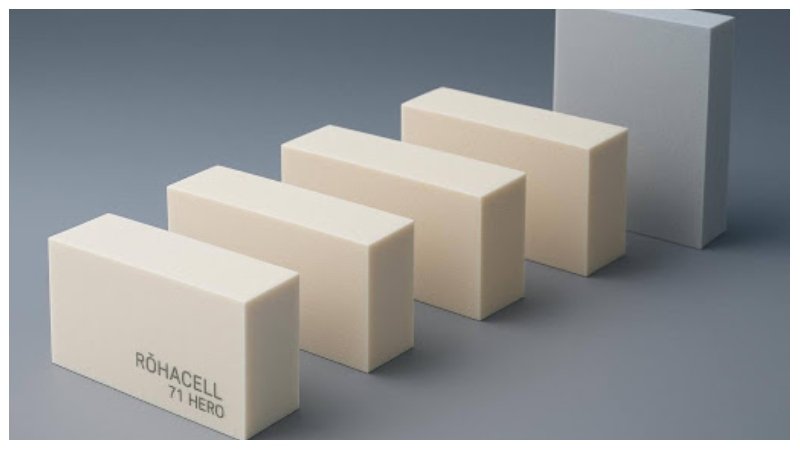
When sourcing ROHACELL foam, engineers and composite purchasing teams must look at how operating loads, autoclave or infusion cure cycles, moisture levels, approved regulations, and total processing costs work together. Comparing sheet prices alone can lead to poor decisions. Buying this polymethacrylimide (PMI) rigid core is a controlled engineering and qualification process. The selected grade must handle the required temperatures and pressures, work with the resin system, and come with a traceable history from the manufacturing plant to the cleanroom.
Structural cores carry shear loads, limit compression, and help preserve the aerodynamic shape of advanced sandwich parts. For this reason, purchasing mistakes can be expensive. An unverified grade or incorrect delivery condition may cause core crushing during curing, steam blisters inside the panel, or delays in approving flight hardware. Fabricators that source specialized materials such as ROHACELL foam from Chem-Craft understand that reliable composite parts depend on decisions made during the specification stage, well before the autoclave cycle starts.
What to Consider When Sourcing ROHACELL Foam
Buying polymethacrylimide (PMI) core material requires more than selecting a familiar trade name. Unlike common packaging or building foams, ROHACELL is a closed-cell, uniform structural polymer made to withstand high processing temperatures and demanding service conditions. Before placing an order, sourcing teams must define the mechanical requirements, regulatory needs, and expected behavior after curing.
A clear specification helps prevent expensive production delays. The material is used in industries that range from commercial aerospace to high-performance motorsport. Purchasing managers must review several technical points at once, including mechanical limits, resistance to the operating environment, dimensional accuracy, and compatibility with the resin system.
Define the Required Mechanical and Thermal Performance
Every sourcing brief should begin by describing the core’s working conditions and processing limits. ROHACELL is known for a high strength-to-weight ratio and strong heat resistance, but the available grades do not all perform in the same way. Buyers should identify the highest continuous service temperature and the short-term peaks that occur during composite curing. These temperatures can reach 180°C (356°F), with pressures as high as 0.7 MPa (7 bar).
Mechanical loads also determine whether a grade will work. Sourcing documents should list compressive strength, shear strength, flexural stiffness, and shear modulus. For flight surfaces or rail structures exposed to repeated loading, fatigue limits and impact resistance may also control the material choice. These values show whether a standard grade is enough or whether a version with greater elongation is needed.
Select the Appropriate ROHACELL Grade
ROHACELL is available in different formulations for specific production methods and industries. Industrial grades such as IG-F or IG suit many commercial structures, medical imaging tables, and automotive body panels. They provide useful stiffness and heat resistance up to 130°C. Aerospace primary structures may require approved grades such as WF, WF-HT, or HERO.
The wrong grade can create production problems. ROHACELL HERO, for example, can provide elongation at break up to three times higher than standard PMI foam. It was made for aerospace applications that require visible impact damage and resistance to hail or bird strikes at temperatures down to -55°C. RIMA grades use a very fine cell structure to limit resin uptake during vacuum infusion. Grade S offers self-extinguishing fire behavior for passenger cabin applications.
Match Foam Density to Strength, Weight, and Cost Targets
Density has a direct effect on compressive and shear performance. ROHACELL grades are identified by their nominal density, from lightweight 31 kg/m³ versions to heavy-duty blocks at 300 kg/m³. For example, 31 IG has a compressive strength of about 58 psi, while 71 IG reaches about 218 psi. Some high-density grades provide compressive resistance of several megapascals.
Purchasing teams must balance safety margins against finished-part weight. A denser core provides more shear modulus and mechanical strength, but it also adds weight and raises the material price. Engineers should calculate the lowest density that can resist mold pressure during production without crushing. Choosing a much denser core simply as a precaution can increase cost without adding useful performance.
Confirm Panel Thickness, Dimensions, and Tolerances
ROHACELL begins as a cast block and is then sliced into rigid sheets or machined into three-dimensional shapes. Quote requests should state the required thickness, width, length, and cutting tolerances. A difference of just a millimeter across a large aerodynamic panel can cause uneven tool closure, dry areas in the fiber, or pools of resin during production.
Fabricators should also compare the cost of flat stock with the cost of pre-machined net shapes. Facilities without high-speed multi-axis CNC routers or suitable dust-collection systems may save money by ordering custom-thickness panels or finished core kits. Step-downs, chamfers, and tapered edges can be produced by a specialist, reducing shop waste and internal labor.
Check Compatibility with Resins, Adhesives, and Composite Processes
ROHACELL forms the inner shear layer in sandwich structures, so its interaction with the surrounding resin and bonding adhesive matters. Its closed-cell polymethacrylimide structure generally resists solvent attack from common composite systems, including epoxy, bismaleimide (BMI), polyester, and vinyl ester resins.
Chemical compatibility is only one part of the check. The adhesive must wet the cut surface well enough to grip the exposed cells. The foam’s heat limit must also match the cure behavior of the prepreg or infusion resin. A poor match can lead to excessive heat from the reaction, steam blisters, or uneven shrinkage.
How Will ROHACELL Foam Be Processed?
Your production method should guide the material order. The way the foam will be shaped, cured, and compacted determines the grade, pre-treatment, and surface finish needed at delivery. High-pressure autoclaves, heated compression molds, and room-temperature infusion place different loads on the cellular structure.
A material prepared for the wrong process can result in defective laminates. Matching the purchasing specification to the actual conditions on the factory floor helps the foam retain its shape from the initial stock form through final demolding.
Compression Molding and Resin Infusion Requirements
In liquid composite molding methods such as Resin Transfer Molding (RTM) and Vacuum-Assisted Resin Infusion (VARI), the shape and size of the cells matter. Liquid resin naturally enters cells exposed at the cut surface. Conventional open-cell cores may absorb a large amount of resin, adding unwanted weight and increasing material costs.
For these methods, fine-pore grades such as ROHACELL RIMA or RIMA-HT can limit resin movement into the surface cells. Closed-cell foam also limits air and solvent flow. Large panels used in infusion may need machined flow channels or shallow grooves so air can leave the mold and resin can spread evenly through the laminate.
Autoclave Temperature, Pressure, and Cure-Cycle Limits
Prepreg curing in an autoclave exposes sandwich parts to high pressure and heat at the same time. Standard ROHACELL grades can handle cures up to 130°C, while many advanced aerospace prepregs require 180°C (356°F) and vessel pressures of up to 0.7 MPa, or about 7 bar.
High-temperature work may require heat-treated grades such as WF-HT or HERO. If untreated or damp foam enters a high-temperature autoclave, trapped water can turn into steam. This may expand the internal pores, crush local areas, or separate the skin from the core. Ordering foam that has been dried and heat-stabilized at the factory reduces the risk of serious autoclave defects.
Machining, Cutting, and Forming Considerations
ROHACELL can be machined dry with common tools used for wood and plastics. Suitable equipment includes carbide or diamond-coated CNC end mills, band saws, and orbital sanders. Hot-wire cutting must not be used. It can char the polymer, break cell walls, and release harmful vapors.
Complex single- or double-curved parts may need thermoforming. Thin sheets can be formed at moderate temperatures, while thicker sections need controlled heating between 170°C and 190°C (338°F to 374°F). The part should then cool under clamping tools to control its shape. Purchasing teams should decide whether forming can be done internally or should be assigned to a conversion partner with accurate forming dies.
Surface Preparation for Bonding and Lamination
A strong skin-to-core bond starts with a clean surface. The cut cell walls give film adhesives, foaming adhesive tapes, and laminating resins a surface for mechanical grip. CNC machining can leave fine, electrically charged dust inside the surface cells. If this dust remains, the adhesive may not wet the foam correctly.
Before lamination, vacuum the surface or use dry, oil-free compressed air to remove loose particles. For demanding joints, light scoring, needle-roller perforation, or shallow micro-grooves can provide more mechanical grip and help air escape during a later cure. Typical grooves are about 1 to 1.5 mm deep and 2 mm wide.
What Documentation and Compliance Should You Request?
In safety-critical applications, a piece of core without certification has little practical value. PMI foam purchasing for high-performance parts requires quality records that satisfy company audits, defense requirements, and civil aviation authorities. The purchase order should list the documents that must be supplied before the shipment leaves the warehouse.
Missing paperwork can stop a production line for weeks while the buyer waits for laboratory testing or tries to trace the supplier history. Stating the required documents in the purchase order allows the material to fit into the company’s quality system without delay.
Aerospace, Automotive, and Industrial Specification Requirements
Aerospace projects must match the material to the applicable aircraft-maker standard. ROHACELL HERO, for example, is approved under major airframer requirements such as Airbus AIMS 04-11-011 and ABS5955. Purchasing agents should place the program specification and revision number on the request for quotation.
Automotive and rail projects may focus on dynamic impact behavior, crash energy absorption, or International Material Data System (IMDS) records. Commercial grades do not all carry aerospace approvals. ROHACELL HE can offer high impact elongation for marine or sports applications, but it does not have civil aviation approval.
Fire, Smoke, Toxicity, and Chemical-Resistance Documentation
Sandwich structures used in passenger areas, including aircraft cabins, trains, and public ferries, must meet strict fire requirements. Purchasing packages should include certified flammability results for standards such as FAR 25.853, which includes a 60-second vertical burn test, or the EN 45545 rail standard.
ROHACELL S uses flame-retardant chemistry to meet demanding Fire, Smoke, and Toxicity (FST) requirements. The buyer should check that the certification applies to the exact thickness and density planned for the finished part. Core density can change how the material burns.
Batch Traceability and Quality-Control Records
Each shipment should include a Certificate of Conformity (CoC) and batch-specific inspection reports. These records should show that the lot meets the density range, tensile properties, and compressive limits listed in the main technical specification.
Defense and aerospace contracts require a full record that connects the raw polymer batch, expansion oven run, and conversion log to each physical panel. Purchasing teams should use strict chain-of-custody procedures. Intermediate distributors must not mix lots or remove the lot information while trimming the sheets.
Sustainability, Recycling, and Regulatory Information
Current regulations call for clear information about hazardous ingredients and end-of-life handling. Purchasing packages should contain current Safety Data Sheets (SDS) and compliance statements for global rules such as REACH and RoHS.
Polymethacrylimide has a highly cross-linked, thermoset-like structure. It cannot be melted and recycled in the same way as PET or common thermoplastics. Disposal instructions usually favor controlled thermal treatment, such as energy recovery in a high-efficiency incinerator, rather than landfill disposal. Buyers should review these instructions against their company’s environmental rules.
Should You Buy ROHACELL Foam from an Authorized Supplier?
The supplier can be just as important as the material specification. PMI foam requires specialized production, and approved supply channels are more likely to store, package, and handle it under controlled conditions.
Gray-market brokers or secondary sellers may quote lower prices, but they can create serious technical risks. Damaged moisture barriers, unknown heat-treatment records, or unverified lot certificates may hide problems that appear only when an expensive sandwich panel blisters inside an autoclave.
Verify Product Authenticity and Supply-Chain Traceability
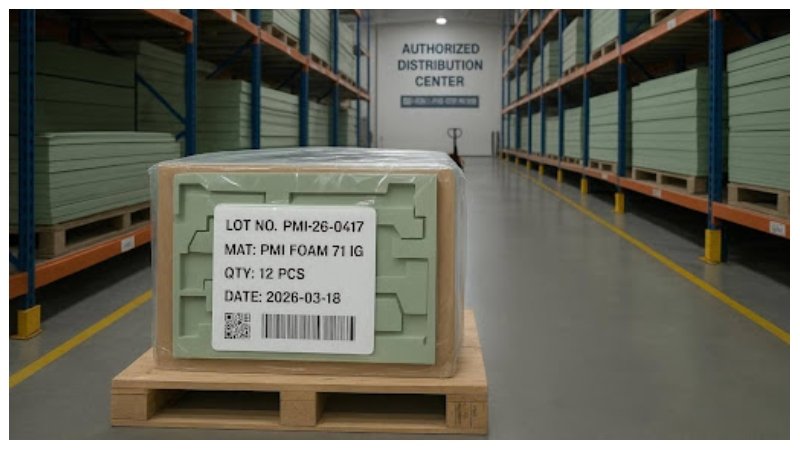
Approved distributors and direct sales networks maintain a documented supply chain, often supported by AS9100 or ISO 9001 certification, from the manufacturer’s casting site to the receiving dock. With a verified supplier, each panel should retain factory markings, lot information, and shelf-life details.
Unapproved brokers may sell excess inventory, old stock, or surplus panels that were kept in uncontrolled conditions. Aerospace-grade or heat-treated foam stored in a humid, unsealed area may lose performance. This can cancel manufacturer warranties and reduce the design values available to the engineer.
Compare Manufacturer, Distributor, and Fabricator Capabilities
The right buying route depends on the project’s volume and technical needs. Options include buying from the primary manufacturer, working with an approved regional distributor, or using a specialist core fabricator. Primary manufacturers are suited to full blocks or large sheet orders, but they may set high minimum quantities and long delivery times.
Regional distributors such as Chem-Craft often keep popular densities in local stock. This makes them useful for prototypes and small production runs. Composite fabricators can add CNC routing, edge potting, thermoforming, and packaged core kits. These services can deliver parts ready for installation in the cleanroom.
Evaluate Technical Support and Application Expertise
An approved supplier can provide application engineers familiar with PMI processing. These specialists may help set thermoforming radii, calculate springback, and account for tool compensation.
If problems occur, such as excess resin movement or unexpected panel distortion, an approved technical partner can review the relationship between foam conditioning, adhesive film choice, and tool heating rates. Gray-market sellers rarely offer this level of help when a problem appears on the production floor.
Check Minimum Order Quantities and Custom Cutting Services
Minimum order quantities can conflict with project budgets. PMI foam blocks are large, and factory-direct orders for unusual densities or thicknesses may require a full production run. That amount may be greater than the project’s immediate need.
Approved stockists may split bulk orders, allowing customers to buy individual sheets or custom panel sizes. Ask whether the supplier performs precision horizontal band sawing and sheet sanding. Pre-planed sheets with close thickness control, such as +/-0.1 mm, remove the need for extra calibration at your facility.
What Are the Cost and Lead-Time Factors?
ROHACELL is a premium structural core for applications where performance matters more than commodity pricing. Its cost per board-foot is naturally higher than that of general-purpose PVC, SAN, or polyurethane foam. Cost control requires a review of both the purchase price and the savings created during conversion and assembly.
Delivery times depend on the grade, density, stock location, and conversion work. Good purchasing plans identify the factors that affect price and delivery so the project can avoid expensive expedited freight and production stoppages.
How Density, Thickness, and Volume Affect ROHACELL Foam Pricing
Material density has a strong effect on price. High-density grades use more starting material and need tighter control during chemical expansion. This makes them more expensive than lower-density grades. Moving from a standard 51 kg/m³ grade to a 110 or 200 kg/m³. core can create a large price increase.
Sheet thickness also affects the price per unit. Very thin sheets need careful horizontal slicing and accurate sanding, which adds processing time and material loss. Ordering standard factory thicknesses in larger quantities may provide volume discounts and reduce packaging charges.
Account for Cutting, Machining, Packaging, and Shipping Costs
The final purchase cost includes more than the raw sheet. Five-axis machining, chamfering, dust removal, and individual protective packaging add labor and equipment charges. Purchasing managers should compare these costs with the cost of doing the work inside the facility.
Freight for lightweight rigid foam is based mainly on volume rather than weight. Large sheets take up considerable trailer or cargo space, so shipping charges can rise quickly. Moisture-barrier aluminum packaging and reinforced wooden crates also add material and handling costs because they protect the sheets from water and impact.
Confirm Stock Availability and Production Lead Times
Common aerospace and commercial grades, including 51 WF, 71 WF, and standard IG thicknesses, are often held at regional distribution centers and may ship within a few days. Special formulations, such as 300 WF heavy-density foam, dielectric HF, or flame-retardant S grades, may need to be made at the primary plant after an order is placed.
Chemical production, block expansion, and post-cure heat treatment can create factory lead times of several weeks or months. Purchasing teams should identify available stock grades early in the design process. If a special grade is necessary, scheduled call-off orders can protect the project from factory backlogs.
Compare Total Procurement Cost Rather Than Unit Price
Comparing materials only by the dollar price of a sheet can give the wrong result. PMI foam costs more at purchase than honeycomb or general-purpose foam, but it can reduce total production cost.
Unlike open honeycomb, ROHACELL does not need complex edge-filling pastes, internal potting compounds, or heavy barrier films. It can be co-cured with prepreg in a single streamlined cycle. This can reduce labor, autoclave time, and total cycle duration. Aerospace production studies have found that replacing honeycomb assemblies with ROHACELL may reduce finished-part manufacturing costs by 20 to 25 percent and reduce component weight by as much as 19 percent.
How Can You Verify ROHACELL Foam Quality?
After the material reaches the receiving facility, a defined inspection process should confirm that it matches the purchase requirements. Internal cell problems and moisture absorption are often invisible during a simple visual check, so visual inspection alone can leave the project exposed to later failures.
A receiving quality process reviews the paperwork, measures dimensions, checks density, and tests physical properties before the material enters usable inventory. Finding a problem at this stage prevents expensive prepreg and labor from being used with foam that does not meet the specification.
Request Technical Data Sheets and Certificates of Conformity
Inspection starts by comparing the supplier documents with the purchase order. Every shipment should include current Technical Data Sheets (TDS) and an authenticated Certificate of Conformity (CoC) showing the matching batch and roll numbers. Reported values should match the specification revision listed on the drawing.
Review the test dates on the quality certificates. Material kept in uncontrolled storage for too long may fall outside its warranty period. The certificate should also state whether the foam is standard stock or has received factory post-curing and heat stabilization.
Check Density, Cell Structure, Thickness, and Flatness
Physical inspection begins with accurate measurements of size and mass. Quality technicians should measure the thickness at several points around the edge and across the center. Calibrated drop indicators or deep-throat micrometers can confirm that the sheet stays within the specified tolerance.
Weighing panels with known dimensions provides a quick density check against the data sheet. Inspect cut surfaces under magnification at the same time. The foam should have a consistent closed-cell structure without internal voids, foreign material, crushed cells, or distortion at the surface.
Confirm Mechanical, Thermal, and Flammability Test Results
For important aerospace and naval structures, receiving inspection may include destructive testing of witness coupons. Standard tests measure compressive strength and shear modulus at room temperature and at elevated service temperatures, using ASTM or ISO methods.
Thermal behavior can be checked with thermomechanical analysis (TMA), which measures the glass transition temperature (Tg) and heat-deflection behavior. Where fire approval is required, samples from the same master production block should undergo 60-second vertical burn tests before the lot is released for production.
Use Sample Parts or Trial Batches Before Volume Orders
When approving a new grade, density, or production method, small sample orders and test panels can reveal problems before a large purchase. Trial sandwich coupons allow the team to check adhesive wet-out, measure springback after thermoforming, and record actual resin uptake under the facility’s infusion conditions.
Ultrasonic non-destructive testing (NDT) of the trial panels can show skin-to-core bond quality, micro-cracks, and adhesive voids that a data sheet cannot reveal. Testing the core in the actual tooling setup gives the production team a stronger basis for a high-volume order.
How Should ROHACELL Foam Be Stored and Delivered?
The transport and storage environment affect how ROHACELL performs on the production floor. Although polymethacrylimide has a high strength-to-weight ratio, it can suffer environmental damage if stored incorrectly. Rough handling or poor warehouse conditions can introduce moisture and cause processing defects.
Clear receiving steps, a controlled warehouse, and careful handling help the core retain its mechanical and heat performance from delivery through final placement in the tool.
Protect Foam from Moisture, Contamination, and Surface Damage
Moisture is the main environmental risk for PMI foam. Humid air can enter exposed surface cells and slowly move into the polymer. Water can soften the material. If damp foam is heated above 100°C in an autoclave, the water can expand into steam and cause blisters, core rupture, or separation between the skin and core.
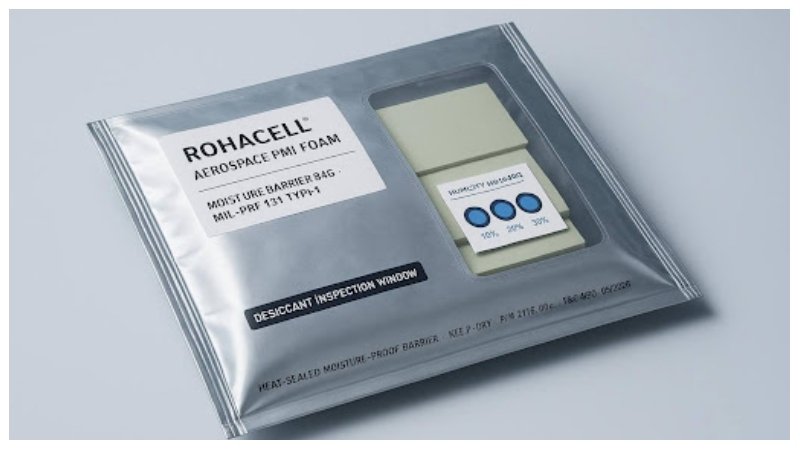
Standard sheets may come with dust protection, but that wrap does not block moisture. Heat-treated grades such as WF-HT or HERO should be sealed in aluminum-lined moisture-barrier bags that meet MIL-PRF-131 requirements. Store the panels indoors, away from direct ultraviolet light, and keep relative humidity below 50 percent where possible.
Check Packaging Requirements for Large or Machined Panels
ROHACELL panels have stiff but fragile edges and corners that can break during transport. Purchase orders should request secure wooden crates or reinforced corrugated containers. Sheets should lie flat and have full-area support to prevent permanent bending or slow deformation.
Pre-machined three-dimensional shapes may have thin feathered edges or complex chamfers. These parts need custom foam trays or thermoformed packaging inserts. A pallet of precision-machined parts with broken edges can stop production and lead to difficult freight insurance claims.
Plan Inventory Levels for Long Lead-Time Projects
Inventory planning must balance storage cost with production needs. Standard, untreated ROHACELL kept in its original dry and UV-protected packaging has a stated shelf life of about five years from the shipment date. Heat-treated grades in special moisture-barrier packaging usually have a shorter certified shelf life, often two years from the date on the quality certificate.
Purchasing teams should avoid buying heat-treated stock too far ahead of the production schedule. A First-In, First-Out (FIFO) or First-Expired, First-Out (FEFO) system helps prevent sheets from reaching the end of their storage period before they reach the lay-up room.
Inspect Material Immediately After Delivery
The delivery dock is the final point at which supply-chain damage can be found before the material enters production. Receiving staff should check containers for holes, crushed corners, and signs of rain before signing the carrier’s paperwork. Any damaged moisture-barrier bag should be recorded and placed in quarantine immediately.
Good receiving practice includes recording delivery times, checking pallet condition, viewing desiccant indicators through clear bag windows, and recording incoming tare weights. A well-organized inspection area allows delivery problems to be resolved before the foam reaches cutting tables and helps maintain reliable performance in every finished composite part. Click here for more Information.