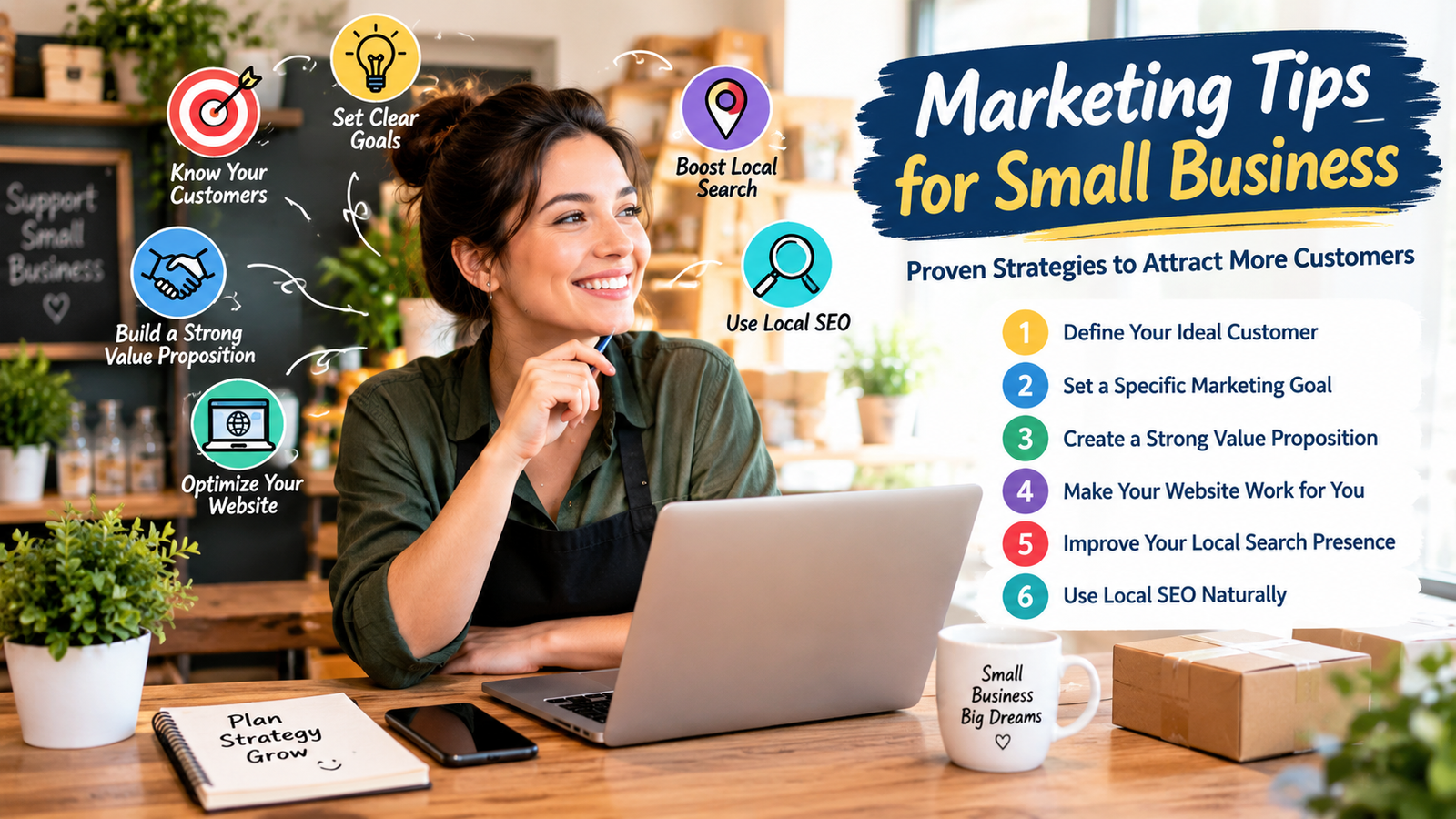
Marketing can feel overwhelming when you run a small business. Limited budgets, a small team, and a long list of responsibilities can make it difficult to know where to invest your time. The right marketing tips for small business can help you reach the right customers, build trust, generate leads, and encourage repeat business without requiring a large advertising budget.
A focused strategy starts with understanding your customers and choosing marketing channels that fit your business model. Instead of trying every available platform, concentrate on a few channels that you can manage consistently and measure properly.
Below are practical strategies that can help a small business build visibility, attract more customers, and turn marketing efforts into measurable business growth.
1. Define Your Ideal Customer
Strong marketing begins with a clear understanding of the people you want to reach.
Take some time to identify your ideal customer. Consider their needs, location, interests, buying habits, challenges, and reasons for choosing one company over another.
For instance, a local bookkeeping company may focus on freelancers and small-business owners rather than trying to reach everyone in the community.
A well-defined audience also makes your messaging more specific. Instead of creating generic advertisements, you can address the exact problems your potential customers want to solve.
Consider these questions:
- What problem does my business solve?
- Who experiences that problem most often?
- What factors influence their buying decision?
- Where do they search for solutions?
- What concerns could stop them from making a purchase?
The answers can guide your website, content, social media, email campaigns, and advertising.
2. Set a Specific Marketing Goal
Marketing becomes easier to manage when you know exactly what you want to achieve.
Some businesses need more phone calls, while others want online sales, newsletter subscribers, store visits, or qualified leads. Your objective should reflect the current needs of the company.
Instead of setting a vague goal such as “get more customers,” choose something measurable.
For example:
Generate 25 qualified leads from the website within the next three months.
A specific target gives you something to measure. It also helps you decide which activities deserve your limited time and budget.
3. Create a Strong Value Proposition
Potential customers should quickly understand why your business deserves their attention.
A value proposition explains what you offer, who it helps, and what makes the offer useful or different.
Avoid broad claims such as “We provide the best service.” Such statements are difficult to prove and rarely tell customers anything meaningful.
A better message might explain a specific benefit:
“We help local restaurants simplify their monthly bookkeeping without hiring a full-time accountant.”
Clear positioning makes every marketing channel more consistent. Your website, advertisements, social profiles, and sales messages can all communicate the same core benefit.
4. Make Your Website Work for Your Business
A website should do more than display your company name and contact details. It should help visitors understand your offer and take the next step.
Important website elements may include:
- A clear homepage
- Easy-to-understand service or product descriptions
- Contact information
- Customer reviews
- About information
- Frequently asked questions
- Strong calls to action
- Location and service-area details
Someone visiting your website should not have to search through several pages to figure out what you sell.
Keep the navigation simple and make important actions obvious. Depending on the business, useful calls to action could include Get a Quote, Book an Appointment, Call Now, or Shop Products.
Mobile usability matters too. Many potential customers will discover your business through a phone, so pages should remain easy to read and navigate on smaller screens.
5. Improve Your Local Search Presence
Local businesses have an important advantage: they can reach people who are actively looking for nearby products and services.
Start by creating or claiming your Google Business Profile. Keep the business name, address, phone number, hours, website, category, and service information accurate.
High-quality photos can also help potential customers understand what your business looks like and what you offer.
Customer reviews deserve attention as well. Ask genuine customers for honest feedback after providing a good experience. Respond to reviews professionally, including criticism.
A strong local presence can make it easier for nearby customers to discover and evaluate your business.
6. Use Local SEO Naturally
Local SEO should focus on usefulness rather than repeating a city name throughout a page.
Create content that genuinely helps people in the areas you serve. A landscaping company, for example, could publish seasonal lawn-care advice that applies to homeowners in its region.
Service-area pages can also be useful when they contain unique and relevant information. Simply creating dozens of nearly identical pages with different location names adds little value.
Think about what a local customer needs to know before contacting your business. Answer those questions clearly and provide information that demonstrates your knowledge of the area and service.
7. Create Content Around Real Customer Questions
Content marketing becomes much more effective when it starts with customer problems.
Before creating an article, video, or guide, think about questions people ask before purchasing from your company.
A roofing company could answer questions about roof inspections, repair warning signs, replacement timelines, and contractor selection.
A software provider might explain how to compare solutions, avoid implementation problems, or calculate the potential value of a new system.
Useful content can attract people earlier in the buying journey. It also gives your business an opportunity to demonstrate knowledge before asking the visitor to make a purchase.
8. Focus on Helpful SEO
Search engine optimization should support the reader rather than turn an article into a collection of repeated keywords.
Start by understanding the searcher’s purpose. Then create content that provides a complete and clear answer.
Use descriptive headings, relevant examples, helpful explanations, and related terminology where appropriate. Internal links can also guide readers toward useful pages on your website.
Most importantly, write naturally.
Repeating the same keyword in every paragraph can make an article uncomfortable to read and may weaken the overall quality. A well-organized article can communicate its topic clearly without forcing the exact phrase into every section.
9. Select Social Media Platforms Strategically
Being active on every social network is rarely necessary for a small business.
Look at your audience first. Identify the platforms where potential customers actually spend time and choose one or two that your team can manage consistently.
A clothing business might benefit from visual content, while a B2B consultant could gain more from professional networking and educational posts.
Social content can include:
- Customer stories
- Product demonstrations
- Short tutorials
- Behind-the-scenes content
- Industry advice
- Frequently asked questions
- Team introductions
- Educational videos
Consistency matters more than trying to publish constantly. A realistic schedule is easier to maintain and usually produces better-quality content.
10. Build an Email Marketing List
Email provides a direct way to stay connected with people who have already expressed interest in your business.
Give visitors a useful reason to subscribe. Depending on your industry, you could offer a checklist, guide, template, discount, product update, or educational resource.
Once subscribers join your list, avoid turning every message into a sales pitch.
Useful newsletters can include practical advice, company updates, helpful resources, product information, and occasional promotions. Over time, consistent communication can strengthen customer relationships and encourage repeat purchases.
11. Encourage Authentic Customer Reviews
Trust plays a major role in purchasing decisions.
Potential customers often look for feedback from people who have already used a product or service. Genuine reviews can provide useful insight into the customer experience.
After completing a successful transaction, make it easy for customers to share honest feedback.
Never create fake reviews or manipulate customers into leaving misleading testimonials. Authentic feedback provides much stronger long-term value.
Negative reviews can also provide an opportunity to demonstrate professionalism. Respond calmly, acknowledge legitimate concerns, and offer a practical way to resolve the issue when appropriate.
12. Turn Satisfied Customers Into Referrals
Word-of-mouth remains valuable because recommendations often come with built-in trust.
Make referrals easy for happy customers. A simple referral process can encourage people to introduce your business to friends, colleagues, or family members.
Depending on the business model, a referral program might include:
- Discounts
- Account credits
- Exclusive benefits
- Complimentary services
- Loyalty rewards
However, incentives should support—not replace—a good customer experience.
Customers are much more likely to recommend a company when the service is reliable, communication is clear, and problems are handled properly.
13. Partner With Complementary Businesses
Strategic partnerships can expose your business to a relevant audience without requiring a major advertising investment.
Look for companies that serve similar customers but do not directly compete with you.
Examples include:
- A wedding photographer partnering with a wedding planner
- A real estate agent working with a home inspector
- A fitness coach collaborating with a nutrition professional
- A web designer partnering with a branding consultant
- A moving company connecting with local real estate professionals
Joint content, referrals, workshops, bundled offers, and cross-promotions can benefit both businesses.
The best partnerships work because both sides provide something valuable to the same type of customer.
14. Use Video to Show Your Expertise
Video gives potential customers a chance to see how your business works and hear directly from the people behind it.
Professional equipment is not always necessary. A smartphone, good lighting, clear sound, and useful information can be enough for many types of content.
Consider answering common customer questions through short videos.
A mechanic could explain warning signs that indicate a vehicle needs attention. A restaurant could demonstrate how a popular dish is prepared. A consultant could explain a common mistake that costs businesses money.
Educational videos can also be reused as social posts, email content, website resources, or longer guides.
15. Start With Low-Cost Marketing Channels
A limited budget does not mean a business cannot market effectively.
Several activities can be started with relatively little financial investment:
- Local SEO
- Customer referrals
- Reviews
- Helpful blog content
- Email marketing
- Business partnerships
- Organic social media
- Community involvement
These channels require time and consistency, but they can create valuable assets that continue working over the long term.
Once you understand which channels produce results, you can decide where additional spending makes sense.
16. Use Paid Advertising With a Clear Objective
Paid advertising can accelerate growth, but it should support a specific business goal.
Before launching a campaign, decide what success looks like.
Possible objectives include:
- Generating leads
- Increasing product sales
- Getting phone calls
- Promoting a service
- Driving appointment bookings
- Reaching a new local audience
Do not judge an advertisement only by the number of clicks it receives.
A campaign can generate thousands of visitors without producing meaningful business results. Look at conversions, qualified leads, customer acquisition costs, and revenue instead.
Start with a controlled budget. Once the data shows that a campaign is profitable or moving toward profitability, consider scaling it.
17. Keep Existing Customers Engaged
Customer acquisition is only one part of growth.
Existing customers already know your business, so maintaining a strong relationship with them can create opportunities for repeat purchases and referrals.
Depending on your industry, you might use:
- Follow-up emails
- Loyalty programs
- Personalized recommendations
- Maintenance reminders
- Helpful product education
- Exclusive offers
- Customer support
A good retention strategy begins with the customer experience itself. Marketing cannot compensate for poor service.
18. Measure Marketing Performance
Good marketing decisions require more than assumptions.
Track the numbers that connect marketing activity to business outcomes.
| Marketing Channel | Metrics to Watch |
|---|---|
| SEO | Organic traffic, leads, conversions |
| Open rates, clicks, leads, sales | |
| Social media | Engagement, inquiries, conversions |
| Paid ads | Cost per lead, conversions, revenue |
| Local SEO | Calls, website visits, direction requests |
| Referrals | Referred customers and sales |
| Content | Traffic, leads, assisted conversions |
The most impressive-looking metric is not always the most useful one.
A post with 10,000 views may produce fewer customers than a small article that attracts 200 highly relevant visitors. Focus on outcomes that matter to your business.
19. Repurpose Content to Save Time
Small-business owners often have limited time for content creation. Repurposing can make each piece of content work harder.
For example, one detailed article could become:
- Several social posts
- A short video
- An email newsletter
- A checklist
- A customer FAQ
- A presentation
- A series of short tips
Customer questions can be repurposed in the same way. A question answered during a sales call might become a blog post, video, social update, or FAQ.
This approach reduces the pressure to constantly create completely new ideas.
20. Follow a Simple 30-Day Marketing Plan
A practical schedule can turn a long list of ideas into manageable actions.
Week 1: Build the Foundation
Start by defining your ideal customer and choosing one primary marketing goal.
Review your website and improve the pages that customers use most. Make sure your business information is accurate and your value proposition is easy to understand.
Week 2: Improve Online Visibility
Claim or update your Google Business Profile if relevant to your business.
Research questions customers frequently ask and choose a few useful topics for future content.
Publish one strong piece of content instead of several low-quality posts.
Week 3: Build Customer Relationships
Ask satisfied customers for honest reviews.
Begin or improve your email list and publish useful social content.
Reach out to complementary businesses that could become potential partners.
Week 4: Review the Results
Look at website traffic, inquiries, leads, sales, email activity, and other metrics related to your goal.
Identify the activities that produced meaningful results.
Keep the tactics that show promise and adjust the ones that underperform. Marketing should become more focused as you learn what your audience responds to.
Common Marketing Mistakes Small Businesses Should Avoid
Even a good marketing plan can lose effectiveness when basic mistakes get in the way.
Trying to Reach Everyone
A business that targets everyone often struggles to communicate a compelling message. Start with the audience most likely to need your product or service.
Copying Competitors
Competitor research can reveal useful ideas and gaps, but copying their articles, messaging, or campaigns will not create a distinctive brand.
Study what customers need, then develop your own useful perspective.
Using Too Many Channels
Every platform requires time. Spreading a small team across too many channels can reduce the quality of everything you publish.
Choose the channels that best match your audience and resources.
Publishing Without a Purpose
Not every business needs to publish content simply to appear active.
Each article, video, email, or social post should have a reason. It might answer a customer question, build trust, generate a lead, support a product, or strengthen an existing relationship.
Ignoring Conversion
Website traffic alone does not pay the bills.
Make sure visitors have a clear next step that matches their intent, whether that means contacting you, requesting information, booking an appointment, or purchasing a product.
Changing Strategies Too Quickly
Some marketing channels need time to produce reliable data.
Give a strategy enough time to evaluate its performance while continuing to fix obvious problems. Constantly switching tactics can make it difficult to determine what actually works.
How Much Should a Small Business Spend on Marketing?
There is no universal marketing budget that suits every small business.
Your spending should depend on revenue, profit margins, competition, customer acquisition costs, business goals, and available cash flow.
Businesses with limited resources can begin with activities such as SEO, local search, referrals, customer reviews, email, useful content, and partnerships.
Paid advertising can come later when you have a clear offer and a reliable way to measure results.
Before spending money, ask a simple question:
What business result do I expect this investment to produce?
That question can help prevent unnecessary spending.
Which Marketing Strategy Should a Small Business Choose?
The right strategy depends on how your customers discover and evaluate businesses like yours.
A local service company might prioritize local SEO, customer reviews, referrals, and community partnerships.
An online store may focus on SEO, email marketing, social content, and paid advertising.
A B2B consulting company could prioritize educational content, networking, professional social media, and email outreach.
A new business with a very small budget may begin with referrals, partnerships, local visibility, and helpful content.
There is no need to copy another company’s marketing mix. Use your customers’ behavior and your own performance data to decide where to focus.
Frequently Asked Questions
What are the best marketing tips for a small business?
Start by understanding your target customer and setting a clear goal. Then build a trustworthy website, improve local visibility, create useful content, collect authentic reviews, encourage referrals, use relevant social platforms, and measure your results.
How can I market my small business with a limited budget?
Focus on activities that require more consistency than spending. Local SEO, referrals, customer reviews, useful content, email marketing, partnerships, and organic social media can all provide opportunities without requiring a large advertising budget.
Is social media necessary for every small business?
Not necessarily. Social media is useful when your target customers actively use the platform and you can consistently provide valuable content. A business should choose channels based on audience behavior rather than popularity alone.
How long does small-business SEO take to produce results?
The timeline varies by industry, competition, website quality, content, and location. Some improvements may become noticeable relatively quickly, while stronger organic visibility often requires consistent effort over a longer period.
Should I spend money on paid advertising?
Paid advertising can make sense when you have a clear offer, a defined audience, and a way to measure conversions. Start with a manageable budget and evaluate actual business results before increasing your spending.
Final Thoughts
Successful small-business marketing is not about doing everything at once.
A stronger approach begins with understanding the customer, communicating a clear value, building trust, and choosing a manageable set of marketing channels. Click here for more information.
Your website, local presence, useful content, reviews, referrals, email, social media, and advertising can all play a role. The right combination depends on your customers and business model.
Start with a few strategies that directly support your goal. Measure the results, learn from customer behavior, and gradually invest more effort into the activities that produce meaningful outcomes.
The best marketing tips for small business are the ones you can execute consistently, improve over time, and connect to real business results.