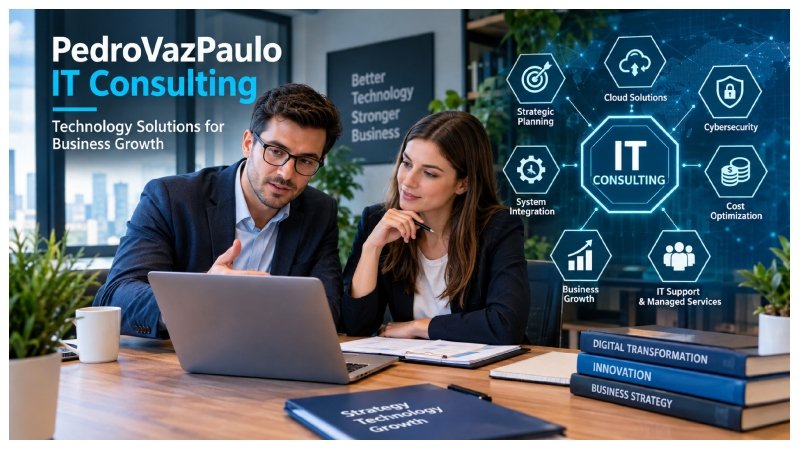
Technology has become an essential part of running a successful business. Companies rely on digital systems to manage customer relationships, protect sensitive information, streamline operations, and make informed decisions. Yet choosing the right technology can be difficult when businesses face rising software costs, cybersecurity risks, outdated infrastructure, and rapidly changing digital tools. PedroVazPaulo IT consulting is a search term for people exploring IT consulting and its potential role in business technology management. Understanding this topic requires looking beyond a list of technical services. Business owners also need to know how consulting works, which challenges it can address, what it may cost, and how to evaluate a provider before making a commitment.
This guide explores the fundamentals of IT consulting, its practical applications, the benefits and limitations businesses should consider, and the steps involved in choosing an appropriate technology partner.
What Is PedroVazPaulo IT Consulting?
IT consulting is a professional service that helps businesses evaluate their technology needs, solve technical challenges, and develop strategies for using digital systems effectively.
The term PedroVazPaulo IT consulting is associated with searches about a named consulting provider and its relationship with business technology. However, the keyword alone does not verify the provider’s current services, qualifications, client results, or business credentials. Anyone considering a specific engagement should confirm those details through reliable sources before proceeding.
More generally, IT consulting connects technical decisions with business objectives. Rather than purchasing new software simply because it is popular, a company can assess its existing systems, identify operational problems, compare available solutions, and prioritize investments according to its goals.
For example, a growing retailer may use separate applications for inventory, sales, and accounting. Employees might spend hours transferring information between systems, increasing the risk of errors. An IT consultant could evaluate whether integration, process improvements, or a more suitable platform would solve the problem.
The objective is not necessarily to introduce more technology. It is to identify the right solution for the business.
Why Businesses Need IT Consulting
Technology decisions influence productivity, security, customer satisfaction, and operating expenses. A structured consulting approach can help organizations make those decisions with a clearer understanding of their options.
Aligning Technology With Business Goals
Businesses sometimes invest in digital tools without establishing what they expect those tools to accomplish. This can lead to overlapping subscriptions, unnecessary complexity, and systems that employees rarely use.
IT consulting can help management translate business objectives into a practical technology plan. That process may involve reviewing current systems, identifying weaknesses, setting priorities, and creating an implementation roadmap.
A company planning to expand into new markets, for example, may need more reliable customer management software, improved reporting, or stronger access controls. A technology roadmap can help determine which changes are necessary before expansion begins.
Improving Productivity and Workflow
Manual processes often consume time that employees could spend on more valuable work. Repeated data entry, disconnected applications, and inefficient approval procedures are common examples.
A consultant can examine these workflows and identify opportunities for automation or integration.
Consider a service business that receives customer inquiries through email, records appointments in a separate calendar, and creates invoices manually. Connecting appropriate systems could reduce duplicate work and improve record accuracy.
However, automation is not always the answer. A process should be understood and improved before it is automated. Otherwise, a business may simply make an inefficient workflow run faster.
Strengthening Cybersecurity
Cybersecurity is an ongoing business responsibility, not just a technical concern. A compromised account, exposed customer database, or unavailable business application can interrupt operations and damage customer trust.
IT consulting may help organizations evaluate risks and improve controls such as multifactor authentication, access permissions, software patching, endpoint protection, employee training, and backup procedures.
A useful security review also considers what happens when something goes wrong. Businesses should know who will respond to an incident, how critical systems will be restored, and how affected stakeholders will be notified when necessary.
No consultant or security product can eliminate every threat. Effective protection depends on appropriate safeguards, continuous maintenance, and regular testing.
Controlling Technology Costs
Technology expenses extend beyond the initial purchase price. Software subscriptions, cloud usage, support contracts, migration work, staff training, and maintenance can significantly affect the total cost of ownership.
A consulting assessment can help businesses identify unused licenses, redundant applications, unnecessary infrastructure, and expensive systems that no longer meet their requirements.
The goal should not be to choose the cheapest option automatically. A low-cost product may create higher long-term expenses if it lacks essential features, requires frequent workarounds, or cannot scale with business growth.
Preparing for Future Growth
Technology that works well for a small team may become unreliable as the organization expands. More employees, additional customers, larger datasets, and new locations can place greater demands on existing systems.
IT planning helps businesses anticipate these requirements and select solutions that can grow with them.
A scalable approach may involve cloud services, modular software, improved network capacity, or clearer data management practices. The appropriate choice depends on the company’s size, technical requirements, budget, and risk tolerance.
Common IT Consulting Services
IT consulting can cover several areas, depending on the provider’s expertise and the client’s needs. Businesses should confirm the precise scope of any specific provider rather than assuming every consultant offers every service.
IT Strategy and Digital Transformation
IT strategy establishes how technology will support business priorities over time. A consultant may review existing infrastructure, identify operational weaknesses, compare potential investments, and recommend a sequence of improvements.
Digital transformation can extend beyond installing new applications. It may involve changing workflows, improving data accessibility, training employees, and establishing clear responsibilities for managing digital systems.
A useful strategy should explain why each recommended change matters, what resources it requires, and how the business will evaluate its results.
Cloud Computing and Infrastructure Management
Cloud computing gives organizations access to computing resources, applications, and storage through network-based services. Depending on their requirements, businesses may use public cloud platforms, private environments, or a combination of both.
Cloud consulting can involve assessing migration options, reviewing infrastructure costs, planning backups, and evaluating access controls.
Before moving systems, companies should consider application compatibility, data sensitivity, service availability, recovery arrangements, and ongoing charges. Cloud adoption can improve flexibility, but it does not automatically reduce costs or remove the need for security management.
Cybersecurity Assessments and Risk Management
Security consulting helps organizations understand potential vulnerabilities and decide which risks require attention first.
An assessment may review account permissions, software updates, network controls, backup practices, incident response procedures, and employee security awareness.
Recommendations should be prioritized according to the likelihood and potential impact of different threats. A small organization may need to address weak authentication and unreliable backups before investing in more complex security products.
Businesses handling regulated or sensitive information should also consider their legal and contractual obligations.
Software Integration and Application Selection
When business applications operate independently, employees may struggle to maintain consistent information. Software integration can allow compatible systems to exchange data and reduce repetitive tasks.
Consultants may help compare products, assess integration options, define technical requirements, and plan implementation.
Before choosing a solution, businesses should evaluate usability, compatibility, vendor support, data portability, security, and licensing conditions. A product that works well for another company may not suit every organization.
Data Analytics and Artificial Intelligence
Data analytics can help businesses understand sales performance, customer behavior, operating costs, and workflow bottlenecks. Artificial intelligence may support selected tasks, including document classification, forecasting, customer service assistance, and routine administrative work.
Successful implementation starts with a clearly defined problem rather than the desire to adopt a fashionable technology.
Businesses should assess data quality, privacy requirements, integration costs, and the accuracy of generated outputs. AI systems can produce incorrect or misleading results, so human review remains important when decisions have significant financial, operational, or customer consequences.
How IT Consulting Helps Different Types of Businesses
The value of consulting depends on the organization’s challenges. The following examples illustrate how different businesses might use technology advice.
Small Businesses and Startups
Smaller organizations often operate with limited budgets and few dedicated IT employees. They may need help choosing essential software, securing business accounts, creating backup procedures, or establishing a reliable technology foundation.
A focused consulting project can help them avoid unnecessary purchases and identify the most important improvements first.
Growing Companies
As a business expands, disconnected systems and informal processes can become harder to manage. Consulting can help evaluate application integration, employee access, infrastructure capacity, reporting, and technology governance.
The priority is to support growth without introducing avoidable complexity.
Established Organizations
Larger businesses may face legacy infrastructure, complicated integrations, extensive security requirements, and coordination challenges across departments.
Consulting can support modernization planning, technology risk assessments, system migrations, and long-term investment decisions. Projects of this scale generally require clear responsibilities, careful testing, and structured change management.
Online Businesses and E-Commerce Companies
Online businesses depend on reliable websites, payment systems, customer databases, inventory tools, and digital marketing platforms.
Technology advice may help them evaluate website performance, access controls, backup arrangements, data integration, and the reliability of third-party services.
Even short interruptions can affect orders and customer confidence, making availability and recovery planning important considerations.
How to Choose an IT Consulting Provider
Selecting a provider requires careful evaluation. A polished website or persuasive sales presentation is not enough to establish technical competence or reliability.
Define the Problem
Write down the challenge you want to address. Examples include excessive software spending, repeated system failures, weak security controls, or inefficient reporting.
A clear problem statement helps providers propose relevant solutions and makes it easier to compare their recommendations.
Verify Credentials and Experience
Ask about relevant qualifications, previous projects, technical expertise, and references where appropriate. Check whether the provider has experience with systems similar to yours.
Certifications can demonstrate knowledge in specific areas, but they should be considered alongside practical experience and the ability to explain proposed solutions clearly.
For a provider identified through the PedroVazPaulo IT consulting search term, independently verify the business identity, official website, current service offerings, and contact information. Do not assume that similarly named domains represent the same organization.
Compare Proposals Carefully
A professional proposal should explain the scope of work, expected deliverables, timeline, pricing, exclusions, and responsibilities.
Look for a clear distinction between advisory work and implementation. A consultant who recommends a solution may not automatically be responsible for installing, maintaining, or supporting it.
Ask questions whenever a proposal includes vague deliverables or promises results without explaining how they will be achieved.
Evaluate Security and Data Handling
Consultants may require access to company systems or confidential information. Before providing that access, review confidentiality agreements, permission levels, data retention, subcontractor arrangements, and incident reporting procedures.
Grant only the access necessary for the agreed work, and ensure that access can be revoked when the engagement ends.
Agree on Success Measures
Define how the project will be evaluated before work begins. Relevant measures might include fewer manual tasks, lower recurring software expenses, improved system availability, or faster recovery from technical incidents.
The measures should reflect the original business objective rather than relying on general promises of increased efficiency.
How Much Does IT Consulting Cost?
IT consulting prices vary according to project complexity, provider experience, location, engagement length, and the type of expertise required. Common pricing arrangements include hourly billing, fixed project fees, monthly retainers, and ongoing service agreements.
Several factors can affect the total cost:
- Project scope: Larger projects usually require more time and coordination.
- Technical complexity: Legacy systems and complicated integrations may require specialist expertise.
- Implementation requirements: Deployment, testing, migration, and employee training add work beyond initial advice.
- Security and compliance: Sensitive information or specific regulatory requirements may create additional responsibilities.
- Ongoing support: Monitoring, maintenance, and periodic reviews can create recurring expenses.
For example, reviewing software subscriptions for a small business is substantially different from migrating a complex database to a new infrastructure platform. The scope, risks, and resources required will differ.
Request a written estimate that identifies included services, additional charges, payment milestones, and post-project support. Comparing proposals on the same scope makes it easier to understand which option offers the best overall value.
Common Mistakes to Avoid When Hiring an IT Consultant
Businesses can reduce unnecessary expenses and implementation risks by avoiding several common mistakes.
Choosing technology before defining requirements: Identify the business problem first, then compare solutions that address it.
Ignoring employee training: Even well-designed systems can fail to deliver value when employees do not understand how to use them.
Overlooking ongoing maintenance: Software updates, licensing, monitoring, and support should be included in long-term planning.
Assuming security is a one-time project: Systems, users, and threats change, so security controls require continued attention.
Accepting guaranteed results without evidence: Ask how a proposed improvement will be measured and what assumptions support the estimate.
Failing to plan for downtime: Backups should be tested, recovery responsibilities should be assigned, and important systems should have appropriate contingency plans.
Rushing implementation: Adequate testing, documentation, and communication can reduce disruption during technology changes.
These precautions help businesses evaluate technology decisions based on evidence, operational needs, and realistic expectations.
Is IT Consulting Worth It?
IT consulting can be valuable when a business faces a technical challenge that requires specialist knowledge, independent evaluation, or a structured implementation plan.
For example, a company experiencing recurring system failures may benefit from a professional assessment that identifies the underlying cause. A business preparing to migrate sensitive data may need help evaluating security, compatibility, and recovery requirements.
However, consulting is not necessary for every technology decision. Straightforward tasks may be handled internally when staff have the appropriate skills and the risks are manageable.
The best approach is to compare the expected benefits with the full cost of the engagement. Businesses should understand what they will receive, how recommendations will be implemented, and how success will be evaluated before committing.
Frequently Asked Questions
What is PedroVazPaulo IT consulting?
PedroVazPaulo IT consulting is a search phrase associated with a named consulting provider and IT consulting services. Readers interested in the specific provider should verify its current offerings, business identity, and qualifications through reliable sources. Generally, IT consulting helps organizations assess technology needs, manage risks, and plan improvements.
What services can an IT consultant provide?
Depending on their expertise, IT consultants may offer technology strategy, cloud planning, cybersecurity assessments, infrastructure reviews, software integration, data analytics, automation advice, and digital transformation planning.
Can IT consulting help a small business?
Yes. A small business may use IT consulting to choose appropriate software, improve account security, reduce redundant technology expenses, or prepare for expansion. The engagement should be tailored to the business’s actual needs and budget.
What is the difference between IT consulting and managed IT services?
IT consulting generally focuses on assessing needs, recommending solutions, and planning improvements. Managed IT services typically involve recurring operational responsibilities such as monitoring, maintenance, troubleshooting, and system administration. Some organizations use both.
How long does an IT consulting project take?
The timeline depends on the project’s scope and complexity. A focused assessment may take considerably less time than a major infrastructure migration or multi-system integration. A written project plan should identify milestones, dependencies, and expected deliverables.
How should a business measure IT consulting results?
Results should be measured against objectives established before the project begins. Depending on the engagement, useful indicators may include reduced manual work, improved availability, lower recurring costs, fewer support incidents, or more reliable recovery procedures.
What should I check before hiring a technology consultant?
Verify the provider’s identity, qualifications, relevant experience, references, scope of work, pricing, security practices, contractual terms, and support arrangements. Avoid making decisions based solely on promotional claims or unverified reviews.
Conclusion
Technology can help businesses operate more efficiently, protect important information, and prepare for future growth, but only when decisions are based on real needs and sound planning. IT consulting provides a structured way to evaluate existing systems, identify risks, compare solutions, and prioritize improvements.
For readers researching PedroVazPaulo IT consulting, the essential next step is to verify the specific provider’s credentials and current services before making a business decision. The broader principles of effective consulting remain the same: define the problem, assess the available options, understand the costs, protect sensitive information, and measure results against clear objectives. Click here for more Information
A thoughtful technology strategy is not about adopting every new tool. It is about selecting, implementing, and maintaining the systems that genuinely support the organization’s goals.