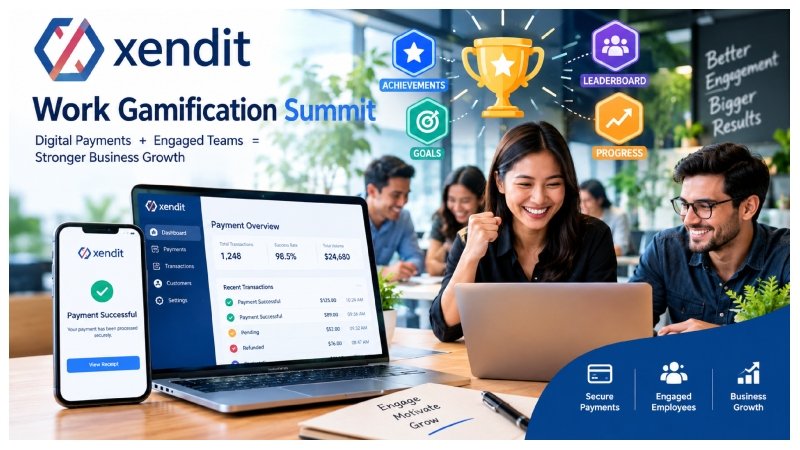
The term Xendit Work GamificationSummit brings together digital payment technology, workplace gamification, and the growing interest in making professional activities more engaging. Businesses today are exploring ways to improve employee participation, simplify digital transactions, and create better experiences for customers and teams. Understanding these concepts can help business owners, managers, and technology professionals identify practical opportunities without confusing online claims with verified facts.
Xendit is a financial technology company that provides payment infrastructure for businesses. Gamification, meanwhile, applies selected game-inspired elements to activities such as employee training, customer engagement, and goal tracking. Although these topics can overlap in practical business scenarios, their connection should be evaluated carefully. This guide explains the meaning of the keyword, explores how gamification works, examines possible applications, and highlights the facts readers should verify before relying on claims about a specific summit.
What Is Xendit Work GamificationSummit?
Xendit Work GamificationSummit is a search phrase associated with Xendit, workplace gamification, and a summit or event focused on game-inspired business strategies. People searching for this term may want to understand how organizations can use engagement techniques, digital tools, and payment technology to support business activities.
However, an important distinction must be made: the phrase itself does not establish that an official conference, Xendit product, or company initiative exists under that exact name. Readers should look for confirmation from primary sources before treating the summit as an officially organized event.
The keyword can be understood through three related concepts:
- Xendit: A payment technology provider offering solutions that help businesses collect payments and manage supported payment workflows.
- Workplace gamification: The use of goals, challenges, feedback, progress indicators, and recognition to encourage participation in professional activities.
- Gamification summit: A general description of an event where professionals discuss gamification strategies, tools, research, and practical applications.
Understanding these elements separately provides a more reliable starting point than assuming they are all part of a single confirmed program.
What Is Xendit and What Does It Offer Businesses?
Xendit provides payment infrastructure designed to help businesses manage digital payment processes. Its services include payment acceptance and other payment-related capabilities, with specific features depending on the product, business requirements, and supported market.
For a business, payment infrastructure can influence how customers complete purchases, how transaction information is recorded, and how payment processes connect with other systems.
Digital Payment Acceptance
Businesses can use supported payment methods to collect money from customers. Depending on the market and configuration, available options may include bank transfers, cards, digital wallets, and other local payment channels.
Offering suitable payment options can make checkout more convenient for customers. Businesses should nevertheless confirm which methods are available for their country, business entity, and intended transaction type.
Payment Links
Payment links allow a business to share a payment page with a customer without necessarily building an entirely new checkout experience.
For example, an event organizer could send a registration payment link to someone who wants to attend a paid workshop. The customer can follow the link and complete the payment using an available method.
Xendit official documentation explains how payment links and supported payment methods work. The exact payment experience depends on the selected method and the configuration of the payment request.
Payment Tracking and Reconciliation
Digital payment systems can help businesses review transaction statuses and organize payment records. This information can support routine financial administration, customer support, and reconciliation.
A business should establish clear procedures for handling pending transactions, failed payments, refunds, and customer questions. A payment marked as initiated should not automatically be treated as successfully completed.
Integration With Business Applications
Businesses may connect payment functionality with websites, applications, and operational systems through supported integrations or APIs.
For example, an online registration platform could use payment status information to determine whether a participant has completed a paid registration. The registration system and payment provider must be configured correctly for this workflow to function reliably.
What Is Workplace Gamification?
Workplace gamification means applying selected elements of game design to professional tasks. Instead of relying exclusively on instructions or traditional performance reports, an organization may introduce clear milestones, progress tracking, feedback, and recognition to make goals easier to understand.
The purpose is not simply to make work entertaining. A well-designed program should help people participate in valuable activities, develop skills, or work toward clearly defined objectives.
Consider an employee training program. Employees could complete short learning modules, receive feedback after assessments, and track their progress toward certification. These features introduce game-inspired mechanics while keeping the main objective focused on learning.
Common Elements of Workplace Gamification
Points and milestones: Points can indicate progress toward a goal, while milestones show participants which stages they have completed.
Challenges and missions: A challenge gives participants a specific objective, such as completing an onboarding module or contributing to a team knowledge base.
Progress bars: Visual indicators make it easier to see how much of a task or learning program remains.
Badges and recognition: Certificates, digital badges, and meaningful acknowledgment can recognize achievements or valuable contributions.
Leaderboards: Rankings can encourage friendly competition in appropriate situations. However, they may also create pressure or unfair comparisons when employees have different responsibilities or resources.
Feedback and rewards: Timely feedback helps people understand their performance. Rewards may include recognition, learning opportunities, or other benefits appropriate to the activity.
These mechanics should be selected according to the problem an organization wants to solve. Adding points to every task does not automatically improve motivation or productivity.
Why Are Businesses Interested in Gamification?
Businesses often look for ways to improve participation, encourage learning, and make progress more visible. Gamification can support these goals when its mechanics are connected to meaningful outcomes.
1. Improving Employee Training
Long training programs can feel difficult to complete when employees cannot easily see their progress. Breaking the material into manageable modules gives learners smaller objectives and opportunities to assess their understanding.
For example, a company could organize product training into weekly lessons. Employees would complete each lesson, answer knowledge questions, and receive feedback explaining any mistakes.
The company could then evaluate assessment results and practical performance to determine whether the training is effective. Completion rates alone are not enough to prove that employees have learned the material.
2. Encouraging Collaboration
Gamification can recognize teamwork rather than focusing exclusively on individual performance.
A company might create a shared challenge in which a team documents useful solutions, helps colleagues, or improves an internal process. Recognition could be based on the quality and usefulness of those contributions.
This approach can support cooperation when employees understand the rules and believe the evaluation process is fair.
3. Making Business Goals More Visible
Employees may find large projects easier to manage when objectives are divided into smaller stages.
A project team, for example, could track planning, development, testing, and delivery through a shared progress board. Each completed stage would provide a clear indication of progress and highlight outstanding work.
The system should reward meaningful results rather than encourage employees to rush through tasks simply to increase their scores.
4. Recognizing Useful Contributions
Recognition can help employees understand which contributions the organization values.
A business could acknowledge mentoring, successful training completion, excellent customer service, or improvements that reduce unnecessary work. Recognition criteria should be clear enough that employees understand how achievements are evaluated.
Organizations should also avoid rewarding only the most visible employees. Quiet but valuable contributions may otherwise go unnoticed.
How Could Xendit and Gamification Be Connected?
Payment technology and gamification address different business needs, but they can potentially work together when an organization has a suitable use case.
A gamification platform might manage challenges, progress, and eligibility for rewards. A payment solution could handle an associated payment transaction when the business’s chosen provider supports that particular workflow.
This is a possible application of payment technology, not evidence that Xendit has officially launched or endorsed a particular gamification program.
Event Registration and Interactive Workshops
Imagine a company organizing a paid professional development event with workshops, group activities, and learning challenges.
The organizer could use a supported payment solution to collect registration fees. Once the payment is confirmed, the event management system could update the registration record and provide the participant with access instructions.
During the event, a separate gamification system might track workshop participation or learning milestones.
In this scenario, payment processing supports registration, while gamification supports the event experience. The organizer would need to confirm that the systems can integrate correctly and that the payment provider supports the intended use case.
Customer Engagement Campaigns
An online business might want to encourage customers to explore a product, complete a tutorial, or participate in a promotional campaign.
A separate application could record eligible activities and determine which customers qualify for a reward. If a reward involves a monetary payment, the business could investigate a suitable payout method and confirm the provider’s requirements.
The business would also need clear eligibility rules, appropriate fraud controls, and transparent communication about the reward.
Gamification software and payment infrastructure should not be treated as interchangeable products. One manages engagement rules; the other handles supported financial transactions.
Employee Rewards
A company could recognize employees for completing training, sharing knowledge, or contributing to team objectives.
Not every reward needs to involve money. Certificates, public appreciation, additional learning opportunities, and professional development may be more appropriate in many situations.
If monetary rewards are used, the organization should establish approval procedures, accurate recipient records, privacy safeguards, and compliance with applicable employment and payment requirements. It should also verify that the chosen payment provider supports the proposed transactions.
Is Xendit Work GamificationSummit an Official Event?
Readers searching for this keyword should pay particular attention to event verification.
Third-party websites may describe a summit, list possible activities, or attribute business results to an organization. Such descriptions do not independently establish that an event took place exactly as reported or that a company officially participated.
The official Xendit materials reviewed for this article establish the company’s payment-related services, but they do not provide sufficient confirmation to identify Xendit Work GamificationSummit as an officially announced Xendit event.
This distinction matters because an article can discuss workplace gamification without claiming that a company organized a particular conference.
Before relying on event-specific information, readers should check the following:
- Official announcements: Look for an announcement on Xendit website or an official company communication channel.
- Event details: Check whether the organizer provides a verifiable event date, location, program, and registration information.
- Speakers and participants: Confirm professional biographies and participation through credible primary sources.
- Published evidence: Look for official recordings, presentation materials, or other documentation that supports specific claims.
- Reported outcomes: Verify statistics about attendance, employee performance, engagement, or revenue before treating them as established results.
The absence of a public announcement does not prove that no related private activity occurred. It means that the specific claim should remain unconfirmed unless reliable evidence becomes available.
Benefits and Risks of Workplace Gamification
Gamification can be useful, but its results depend on design, context, and implementation. Organizations should consider both potential benefits and possible drawbacks.
| Potential benefit | Risk to consider |
|---|---|
| Makes progress easier to understand | Progress scores may not reflect actual quality |
| Encourages participation | Participants may focus on rewards instead of learning |
| Breaks large objectives into smaller steps | Too many challenges can add unnecessary work |
| Provides visible feedback | Poor metrics can encourage undesirable behavior |
| Recognizes valuable contributions | Public rankings can create pressure or resentment |
| Helps evaluate participation | Collecting excessive employee data can undermine trust |
A program is more likely to be useful when it solves a genuine problem, respects participants, and measures outcomes that matter.
For example, rewarding customer support staff only for the number of tickets closed could encourage rushed responses. Measuring resolution quality and customer outcomes alongside efficiency would provide a more balanced picture.
How to Build an Effective Gamification Program
Businesses do not need a complicated platform to begin experimenting with gamification. A structured, small-scale pilot can help them understand whether the approach is suitable.
Identify the Problem
Start with a specific objective. Examples include improving training completion, increasing participation in knowledge sharing, or reducing avoidable errors.
Avoid starting with a reward system before determining what the business actually needs to improve.
Choose Appropriate Mechanics
Select only the mechanics that support the objective.
A progress bar may work well for onboarding, while a collaborative challenge may be better for knowledge sharing. Competitive rankings may be unnecessary if the main objective is cooperation.
Explain the Rules
Participants should understand what counts as progress, how results are evaluated, and what recognition or rewards are available.
Transparent rules help reduce misunderstandings and make the program easier to manage.
Protect Privacy and Fairness
Collect only the information necessary to operate the program. Explain how the information will be used and who can access it.
Account for differences in job responsibilities, accessibility, available resources, and working conditions. Employees should not be disadvantaged by factors outside their control.
Run a Small Pilot
Test the program with a limited group before expanding it across the organization.
Gather feedback about usability, fairness, workload, and motivation. A pilot can reveal problems that would be harder to correct after a company-wide rollout.
Measure Meaningful Results
Choose metrics that match the original objective. Depending on the program, useful indicators could include:
- Training assessment results.
- Quality of completed work.
- Time required to complete a process.
- Participation and completion rates.
- Error frequency or customer satisfaction.
Establish a baseline before the pilot begins. Where practical, use a suitable comparison method to determine whether the program contributed to observed changes.
Improve the Program Based on Evidence
Review the results and adjust the rules, mechanics, or rewards when necessary.
If the program increases pressure, encourages shortcuts, or fails to improve the intended outcome, the organization should revise it or stop using it. Continuing a poorly performing system simply because it has already been implemented wastes resources.
Frequently Asked Questions
What does Xendit Work GamificationSummit mean?
It is a search phrase combining Xendit, workplace gamification, and a summit or event related to game-inspired business strategies. The exact phrase should not be assumed to identify an official Xendit event without supporting evidence.
What is Xendit used for?
Xendit provides payment infrastructure and related services that help businesses accept and manage supported digital payments. Its available features and payment methods depend on the market and business requirements.
What is workplace gamification?
Workplace gamification applies game-inspired elements such as milestones, progress indicators, challenges, feedback, and recognition to professional activities. Its purpose is to support meaningful objectives, such as learning, participation, or collaboration.
Can Xendit be used for event payments?
Xendit provides payment solutions that may support eligible business use cases, including certain one-time payment flows. Businesses should check current documentation and confirm that their specific event, country, and payment requirements are supported.
Does gamification always improve employee productivity?
No. Its effectiveness depends on the design, workplace culture, and objectives. Poorly designed systems may encourage shortcuts, create unhealthy competition, or reward quantity instead of quality.
How can I verify whether a Xendit gamification summit is real?
Check official company announcements, organizer information, event documentation, and credible primary sources. Do not rely exclusively on third-party articles that provide specific speakers, statistics, or outcomes without verifiable evidence.
Is Xendit Work GamificationSummit an official Xendit program?
The official public information reviewed for this article does not establish the exact phrase as the name of an official Xendit program. A reliable confirmation from the company or other primary evidence would be needed to support that claim.
Final Thoughts
Xendit Work GamificationSummit combines several ideas that can be relevant to modern businesses: digital payments, workplace engagement, and gamification-based learning or activities. Xendit payment infrastructure addresses supported financial workflows, while workplace gamification provides ways to make goals, feedback, and progress more visible.
These concepts may complement one another in applications such as event registration, customer engagement campaigns, and carefully designed reward programs. However, potential applications should not be confused with evidence of a particular company partnership, conference, or reported business result.
Businesses considering gamification should begin with a clear objective, select appropriate mechanics, protect participant privacy, and evaluate results using meaningful measures. Readers researching the summit itself should verify official announcements before relying on event-specific claims. Click here for more Information.
Ultimately, the most valuable approach is to focus on accurate information, practical applications, and measurable business needs rather than unverified claims or complicated reward systems.