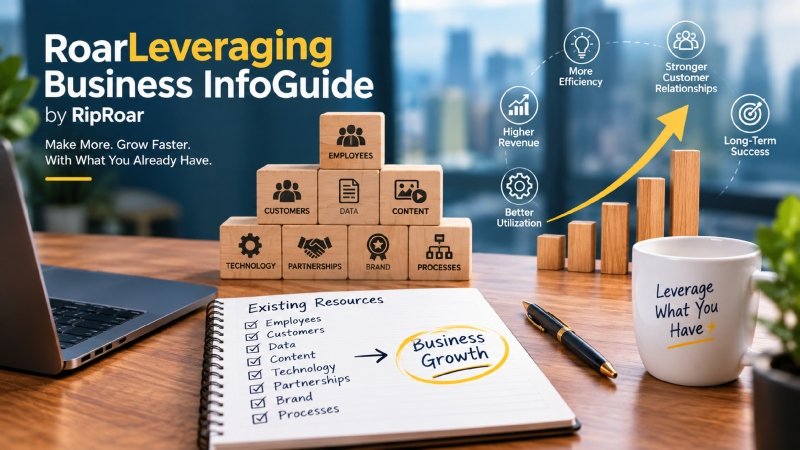
Business growth is often associated with bigger budgets, more employees, new technology, and larger marketing campaigns. But growth does not always require a business to start from scratch. In many cases, the company already has valuable resources that could produce more results if they were identified, organized, and used strategically. That is the central idea behind the RoarLeveraging Business InfoGuide by RipRoar. The concept focuses on finding opportunities within resources a business already possesses and using them more effectively to support growth, efficiency, customer relationships, and long-term business goals.
Instead of asking only what a company needs to acquire next, a leverage-based approach asks a more practical question:
How can the business create more value from what it already has?
This guide explains the concept, its core principles, practical applications, advantages, limitations, and a step-by-step way businesses can put the idea into practice.
What Is RoarLeveraging Business InfoGuide by RipRoar?
The RoarLeveraging Business InfoGuide by RipRoar can be understood as a business strategy concept centered on leveraging existing assets and capabilities.
Those assets can include much more than money or physical equipment. A business may already possess:
- Experienced employees
- Existing customers
- Customer data
- Website traffic
- Brand recognition
- Valuable content
- Business partnerships
- Internal processes
- Software and technology
- Industry knowledge
- Distribution channels
The important part is not simply owning these resources. The real opportunity comes from understanding how effectively they are being used.
For example, a business may have a large customer database but no structured follow-up process. Another company may have highly experienced employees whose knowledge is not being documented or shared. A website might receive consistent traffic while failing to convert that traffic into useful business opportunities.
In each situation, the business may already have an asset with potential value. The challenge is finding a practical way to unlock it.
The Basic Principle Behind Business Leverage
Business leverage means increasing the value or usefulness of an existing resource without necessarily increasing resources at the same rate.
Consider a simple example.
A company creates one detailed industry report. Instead of using it once, the team could turn that report into several articles, an email resource, a presentation, educational social content, and material for customer conversations.
The company has not created an entirely new knowledge base for every channel. It has extended the usefulness of work that already exists.
The same principle can apply to customer relationships, employee expertise, technology, data, partnerships, and operational systems.
This does not mean that businesses should avoid new investment. New employees, technology, capital, and marketing can be essential. The idea is to examine existing resources first so that new investment complements existing strengths rather than unnecessarily duplicating them.
Why Existing Resources Matter
Every business accumulates resources over time.
A company may develop years of customer relationships, collect valuable operational data, build a library of content, establish supplier relationships, and develop specialized employee knowledge.
Yet these assets can become fragmented.
One department may have useful information that another department does not know exists. Customer feedback may be collected but never reviewed. A software subscription may contain features the business rarely uses. Valuable content may remain buried in an old section of a website.
A structured leverage process helps bring these resources into view.
Potential benefits include:
- Better use of existing investments
- More efficient workflows
- Improved customer engagement
- Greater visibility into business performance
- Reduced duplication of work
- Better use of employee expertise
- More informed decision-making
- New opportunities for revenue or retention
The actual outcome will depend on the business, market, execution, and measurement.
Key Areas to Explore for Business Leverage
A useful leverage review should look across the organization rather than focusing on one department.
1. Employee Skills and Knowledge
Employees often possess capabilities that are not fully reflected in their job descriptions.
An employee working in customer support, for example, may understand recurring customer problems better than anyone else in the organization. A salesperson may have detailed knowledge of objections that frequently prevent prospects from purchasing.
That knowledge can potentially improve:
- Training
- Product development
- Customer support
- Sales documentation
- Website content
- Internal processes
- Quality assurance
Businesses can begin by identifying specialized knowledge and determining where it could create additional value.
The goal is not to make employees perform unrelated tasks. It is to recognize useful expertise and create better ways to share it.
2. Customer Relationships
Existing customers represent another important business resource.
Customer relationships can provide information about purchasing behavior, recurring problems, preferences, satisfaction, and future needs.
A company might examine:
- Which customers return most frequently
- Which products are commonly purchased together
- What questions customers repeatedly ask
- Why customers stop purchasing
- Which services generate the most satisfaction
- Where additional support could improve the customer experience
This information can support more relevant communication and product decisions.
However, customer leverage should remain customer-focused. Sending irrelevant promotions simply because a company has customer contact information is not an effective long-term strategy.
3. Business Data
Data can become valuable when it helps answer specific business questions.
A company may have information about:
- Sales
- Website visitors
- Customer behavior
- Marketing campaigns
- Product performance
- Support requests
- Operating costs
- Inventory
- Customer feedback
The first step is not necessarily collecting more data. It is determining what existing information can help the business make better decisions.
For example, a business might discover that one marketing channel generates many visitors but very few qualified leads. Another channel may generate fewer visitors but stronger conversions.
That difference can influence where future marketing resources are allocated.
4. Technology and Software
Technology can help businesses amplify existing capabilities.
Automation, customer relationship systems, analytics platforms, project-management software, and communication tools can reduce repetitive work and improve visibility.
But technology should solve a defined problem.
A common mistake is purchasing software because it offers impressive features without first determining whether those features address an actual business need.
A practical sequence is:
Problem → Desired outcome → Possible solution → Test → Measure
This keeps technology connected to business objectives.
5. Existing Content
Content is another resource that businesses frequently underuse.
A company may already have:
- Blog articles
- Research reports
- Case studies
- Product guides
- Presentations
- Videos
- Customer questions
- Training documents
These materials can sometimes be updated, reorganized, or repurposed.
For example, a detailed guide could become a series of educational articles, a presentation, a video outline, or a customer resource.
Repurposing does not mean publishing the same material everywhere without modification. Each format should provide value in the context where it is used.
6. Partnerships and Networks
Business relationships can also create opportunities.
Suppliers, professional partners, distributors, complementary businesses, and industry connections may provide access to knowledge, audiences, referrals, or capabilities.
A company could review its existing relationships and ask:
- Are there complementary services we can promote together?
- Can we exchange useful industry knowledge?
- Are there referral opportunities?
- Can partners help reach a relevant audience?
- Are there capabilities we can access without building them internally?
Strong partnerships should create value for the parties involved rather than simply adding another promotional channel.
How to Apply the RoarLeveraging Approach Step by Step
Understanding the concept is useful, but implementation is where it becomes practical.
Create an Asset Inventory
Start by listing the resources the business already has.
Organize them into categories such as:
| Category | Examples |
|---|---|
| People | Skills, experience, specialist knowledge |
| Customers | Existing relationships, feedback, purchase history |
| Data | Sales, analytics, customer and operational information |
| Content | Articles, reports, videos, guides |
| Technology | Software, systems, automation |
| Brand | Reputation, messaging, visual assets |
| Partnerships | Suppliers, referrals, strategic relationships |
| Processes | Workflows, SOPs, operating procedures |
This inventory creates a clearer picture of the organization’s current capabilities.
Find Underused Resources
Once the resources are listed, identify those that are producing little value relative to their potential.
Ask questions such as:
- What are we already paying for but barely using?
- Which customer information are we not analyzing?
- What knowledge exists only in one employee’s head?
- Which content could be updated or reused?
- Which processes involve unnecessary manual work?
- Which partnerships have become inactive?
- Which customer problems appear repeatedly?
The answers can reveal areas worth testing.
Connect Each Opportunity to a Goal
An asset should not be optimized simply because it exists.
Connect each opportunity to a measurable business objective.
For example:
Goal: Increase repeat purchases
Resource: Existing customer relationships
Opportunity: Relevant follow-up communication
Metric: Repeat-purchase rate
Or:
Goal: Reduce administrative workload
Resource: Existing software
Opportunity: Automate a repetitive process
Metric: Hours saved per month
This approach prevents leverage initiatives from becoming vague projects.
Prioritize Opportunities
Not every opportunity deserves immediate attention.
A simple prioritization system can consider:
- Potential business value
- Required effort
- Cost
- Time to test
- Risk
- Strategic relevance
A relatively low-cost opportunity with a clear business objective may be suitable for an early experiment.
Run a Small Test
Avoid making large investments before understanding whether an idea works.
Start with a manageable experiment.
For example, instead of redesigning an entire customer-retention system, a company could test one segmented follow-up campaign with a defined customer group.
Instead of rebuilding all internal processes, the company could automate one repetitive workflow.
Small tests provide evidence before larger commitments are made.
Measure What Changed
Every experiment should have an appropriate measurement.
Depending on the objective, businesses might track:
- Conversion rate
- Revenue
- Repeat purchases
- Customer retention
- Qualified leads
- Response rate
- Time saved
- Operating cost
- Customer satisfaction
- Productivity
The measurement should relate directly to the original objective.
Improve or Stop
After testing, there are three reasonable outcomes.
Expand: The evidence supports broader implementation.
Improve: The concept shows potential but needs changes.
Stop: The results do not justify additional resources.
This is important because not every experiment will succeed. Learning which ideas do not work can also prevent wasted investment.
A Practical Example
Imagine a small software company with 2,000 previous customers.
The company spends most of its marketing budget acquiring new prospects, while its existing customer base receives limited communication.
A leverage review identifies the customer database as an underused resource.
The company then:
- Organizes customers according to relevant characteristics.
- Reviews previous purchases and support interactions.
- Identifies customers who may benefit from additional services.
- Creates useful educational resources.
- Sends relevant communication to selected segments.
- Measures engagement and repeat purchases.
- Compares the results with previous performance.
The company has not necessarily discovered a completely new market. It has explored additional value within an existing business relationship.
That is the practical thinking behind resource leverage.
How to Avoid Wasteful Business Leverage
Leverage should improve business performance, not create more complexity.
Several mistakes are worth avoiding.
Do Not Optimize Everything at Once
A company with dozens of possible opportunities can easily become overwhelmed.
Choose a small number of high-relevance opportunities and test them systematically.
Do Not Confuse More Activity With More Value
Publishing more content, sending more emails, or automating more tasks does not automatically create better results.
The focus should remain on outcomes.
Do Not Ignore Data Quality
Poor or outdated information can lead to poor decisions.
Before relying heavily on customer or operational data, businesses should consider whether the information is accurate, current, and appropriate for the intended purpose.
Do Not Over-Automate
Automation is useful for repetitive and predictable work, but some activities require human judgment.
Customer relationships, complex decisions, creative work, and sensitive communication may still require people.
Do Not Forget the Customer
Internal efficiency is valuable, but it should not come at the expense of customer experience.
A process that saves a company time but creates unnecessary frustration for customers may not represent genuine business improvement.
Measuring the Success of a Leverage Strategy
A business should define success before launching an initiative.
A useful framework is:
Resource → Action → Outcome → Metric
For example:
Existing content → Repurpose into targeted resources → More qualified visitors → Qualified leads
Or:
Employee expertise → Create internal training → Faster onboarding → Training time
Or:
Customer relationships → Relevant retention campaign → More repeat purchases → Repeat-purchase rate
This simple framework makes it easier to evaluate whether an initiative is actually producing useful results.
RoarLeveraging Business InfoGuide by RipRoar vs. Simply Spending More
Traditional growth often emphasizes additional inputs:
More budget + More employees + More tools = Growth
A leverage-oriented approach asks a different question:
Existing resources + Better utilization + Measurement = Potential additional value
These approaches are not mutually exclusive.
A growing company may need new employees, technology, capital, or marketing investment. The difference is that a leverage mindset encourages the organization to understand its existing resources before assuming that acquisition is the only path forward.
Who Can Benefit From This Approach?
The principles can be relevant to different types of organizations.
Small Businesses
Smaller companies often have limited resources, making efficient use of existing capabilities particularly important.
Startups
Startups can use resource mapping to understand what they already possess before committing limited capital to additional investments.
Service Businesses
Agencies, consultants, professional firms, and other service providers may find opportunities in existing client relationships, employee expertise, knowledge, and reusable content.
Established Companies
Larger organizations may have extensive resources distributed across teams. Mapping those resources can reveal duplication, unused capabilities, and opportunities for collaboration.
A 90-Day Implementation Framework
Businesses that want a structured starting point can divide implementation into three phases.
Days 1–30: Discover
Focus on understanding the current situation.
- Inventory resources
- Review customer information
- Identify underused assets
-
Examine existing technology
- Review content and processes
- Define business priorities
Days 31–60: Test
Choose a small number of opportunities.
- Design experiments
- Assign responsibility
- Establish measurements
- Launch small tests
- Collect feedback
- Track results
Days 61–90: Evaluate
Use the evidence from the tests.
- Compare results
- Identify successful approaches
- Improve weak areas
- Stop ineffective experiments
- Decide what deserves additional investment
- Document lessons learned
This framework is not a guaranteed growth formula. It is simply a practical way to move from analysis to testing and measurement.
Frequently Asked Questions
What does RoarLeveraging mean in business?
RoarLeveraging refers to the idea of using existing business resources more strategically to create additional value. These resources can include customers, employees, data, content, technology, partnerships, and processes.
Is RoarLeveraging only for small businesses?
No. The underlying principles can be considered by startups, small businesses, service companies, and larger organizations. The specific resources and opportunities will differ by business.
Does business leverage mean avoiding new investment?
No. The purpose is not to avoid investment. It is to understand existing capabilities and use them effectively while deciding where new investment is actually needed.
How can a business identify underused resources?
Start with an asset inventory and examine resources that receive little attention, are only partially used, or are disconnected from current business goals. Customer data, employee expertise, existing content, technology, and partnerships are common areas to examine.
How should businesses measure leverage opportunities?
Measurement should depend on the goal. Relevant indicators can include revenue, retention, conversion rate, qualified leads, productivity, customer satisfaction, cost, or time saved.
What is the biggest mistake when applying a leverage strategy?
One common mistake is focusing on activity rather than outcomes. A business can become busy with new campaigns, tools, or processes without producing meaningful improvement. Every initiative should have a clear objective and an appropriate measurement.
Final Takeaway
The RoarLeveraging Business InfoGuide by RipRoar highlights an important business-growth principle: companies should not overlook the value already present inside their organizations.
Customers, employees, data, technology, content, partnerships, and processes can all represent potential sources of value. But simply possessing these resources is not enough. Businesses need to identify them, connect them to clear objectives, test practical opportunities, and measure the results.
The most useful way to approach the concept is therefore not as a promise of automatic growth, but as a structured way of thinking about resource utilization. Click here for more information.
Start with what the business already has. Find what is underused. Connect it to a meaningful goal. Test a focused improvement. Measure the outcome. Then decide whether to expand, refine, or stop.
That disciplined process can help businesses make better use of existing capabilities while making future investments with greater clarity.